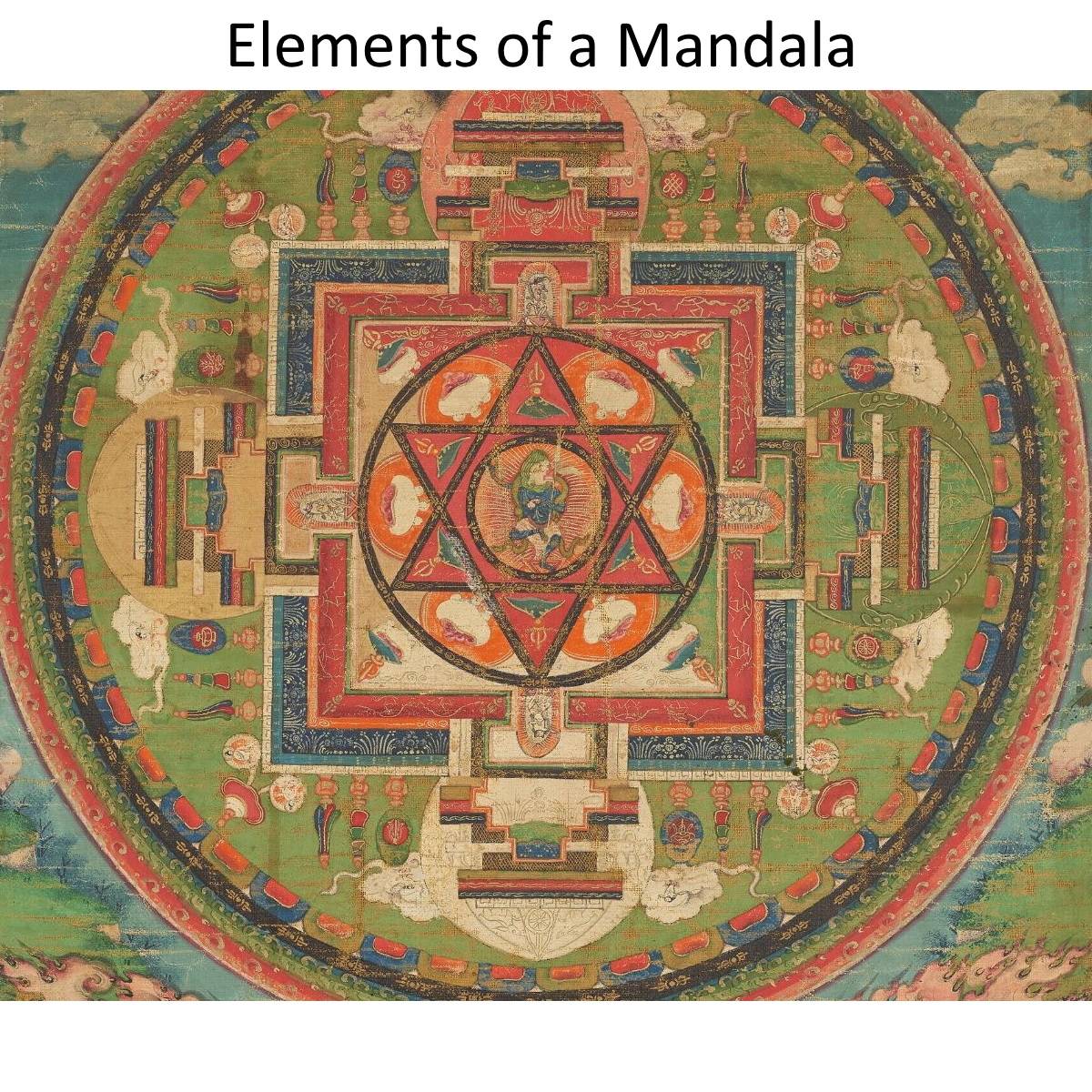
Cemetaries
Cemeteries are sometimes found in tantric mandalas dedicated to the terrifying deities, often the outer ring, it can consist of a circle of eight cemeteries, depicted as stylized charnel grounds, showing corpses, human limbs, scavenging beasts, and skeletons. These images represent both the illusory terrestrial world and the sensations and erroneous mental activities that keep human beings bound to phenomenic appearances; as the cause of samsara, they must be destroyed in order for one to ascend to the plane of the absolute.
Chemchok (Chief of the Mandala).
In Kagyé Chemchok represents enlightened qualities.
Eight Buddha surround the Vairocana Buddha that represent symbolic deities, four male and four female.
For the Mandala there are the walls of the palace with gates towards the four corners of the earth.
Four angry doorkeepers guard the gates of the Mandala.
Four Triangles.
Diagonal lines across the inner square of a mandala sometimes divide it into four triangles. They are directional, being yellow in the south, red in the west, green in the north, and blue in the east, these colors corresponding to the Dhyani-Buddha families of the four directions.
The central point of the intersection of the four triangles represents pure mind, the void, the one, the core of the universe. From this core of pure, undifferentiated wisdom, emanate the four different types of wisdom, symbolized by the Dhyani-Buddhas, located in triangles, representing the four points of the compass. The point at which they converge is the sanctum sanctorum, the domain of the divinity of the mandala. The aspirant seeks to become one with this god; through such union, one can achieve reintegration into the state of Buddhahood.
In the centre of the Mandala, there is a lotus blossom with eight petals, resting on a bed of jewels.
In the Northeast of the Mandala is represented the female Tara the saviour.
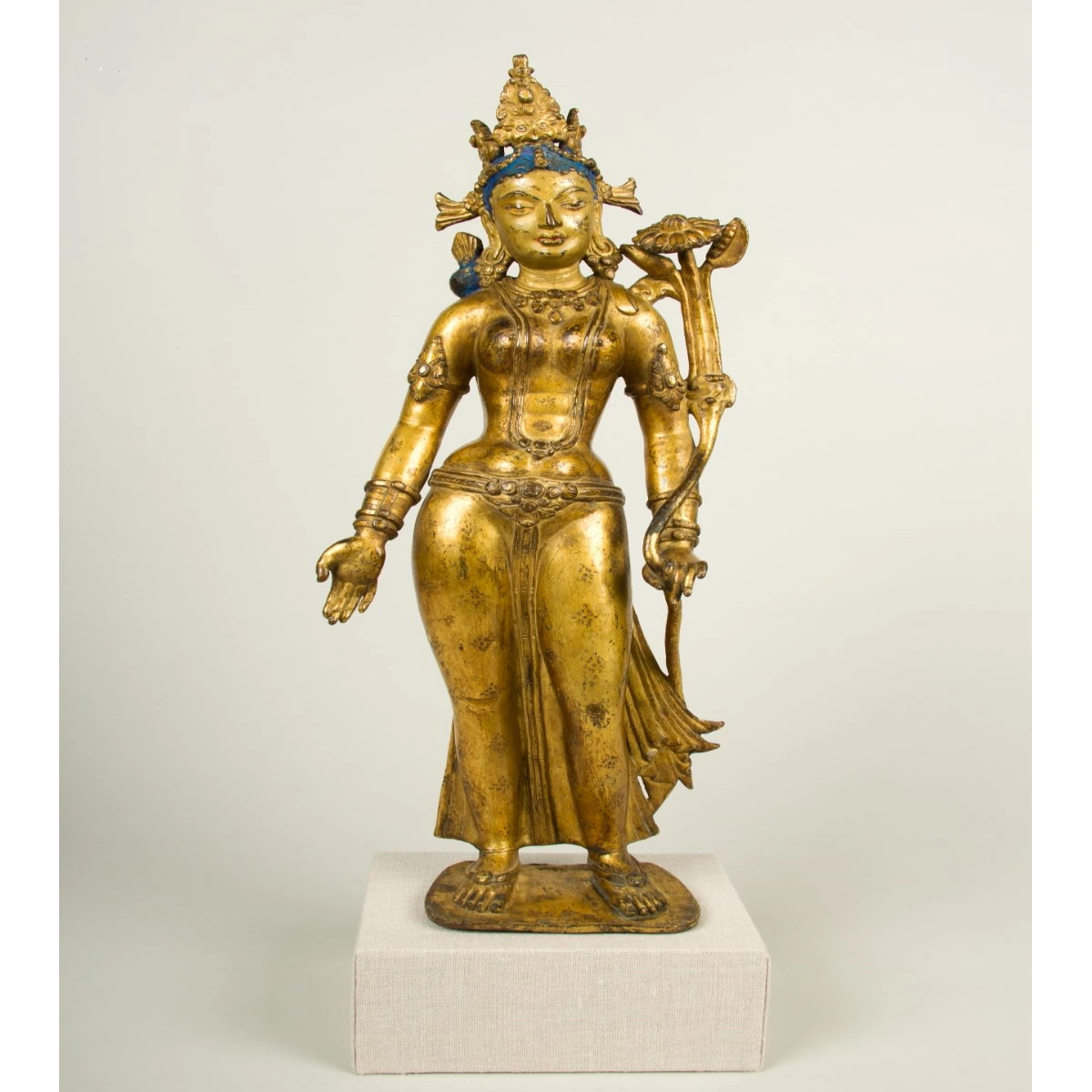
In the Northwest of the Mandala is represented the female Pandaravasini the lady with the white clothing.
In the Southeast of the Mandala is represented the female Locana the eye of buddha.
In the Southwest of the Mandala is represented the female Mamaki the Peculiar.
Inner Square.
Having passed within the concentric outer rings, the aspirant reaches an inner square, the walls of the palace or temple of the deity, or of the royal city. Its outline is that of a traditional Indian temple, a square with four doors. Four guardians usually stand sentinel at the gates.
The eight Buddha face the corners of the earth and form together a lotus flower.
The Mandala has a circle of purifying fire, the outermost circle.
This circle represents a a barrier to cross during meditation.
This is derived from vedic times where fire had been an essential ritual element it has been explained as the periphery of the universe, or the outer wall of the profane world, beyond which lies chaos. To begin the mystical journey, one must leave samsara, the world of phenomena, and pass through this flaming barrier to enter the sacred enclosure of the mandala. According to some interpretations, its purpose is not to terrify the aspirant from entering, but rather to show that the flame of the wisdom contained within the mandala that can burn away ignorance and error. By means of the symbolic fire, understanding of supreme reality may be attained.
The Mandala has a circle of vajra, a diamond circle expressing strength and fearlessness.
This circle represents a a barrier to cross during meditation.
This often inner ring of vajras (or dorje) is inline with the vajra being an emblem of a truth with the power of thunder and also the purity and indestructibility of the diamond, the circle or ring represents the threshold of ultimate reality, the sphere of illumination, of unchangeable, absolute essence.
The Mandala has a circle with the eight tombs which symbolize the eight states of consciousness.
This circle represents a number of gates to open during meditation.
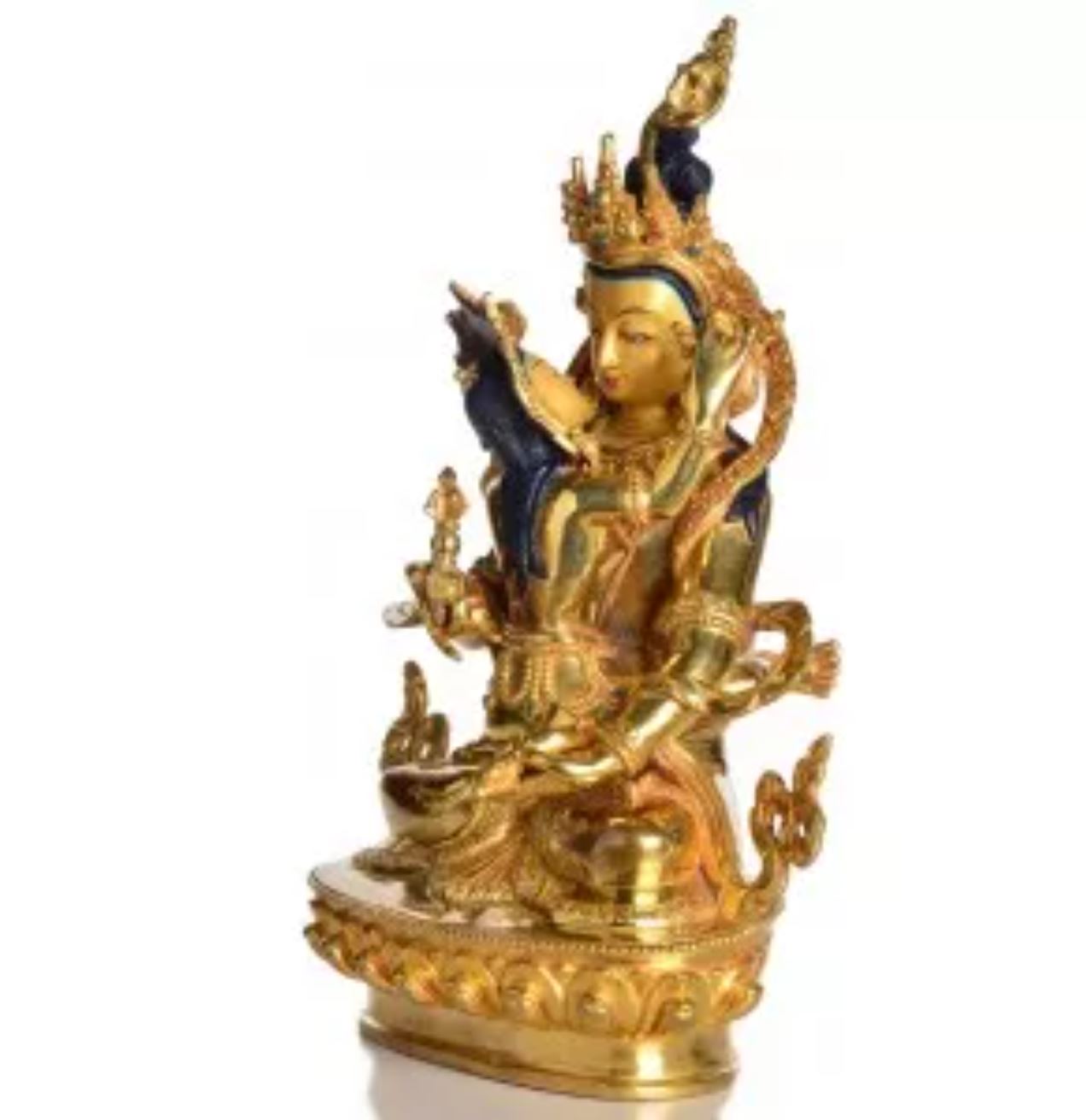
The Mandala is often connected with the Buddha Vajrasattva, who symbolizes the original crystalline purity.
Vajrasattva's name translates to Diamond Being or Thunderbolt Being.
Vajrasattva is often depicted with various consorts and represents as male: the peaceful ones being Vajragarvi or Vajragarva aka Vajrasatvātmikā (Tib. Dorje Nyema), Dharmadhatvishvari, Ghantapani ("Bell Bearer"), the wrathful one being Diptacakra, Vajratopa, Vajrabhrikuti, and others.
It can also be said that Vajrasattva is none other than ourselves, visualized as a pure Buddha. It can be said that Vajrasattva is an emanation of Akshobya or of Vajradhara, or of Samantabhadra. All of these are true at the same time.
You might go before each and every buddha dwelling in the ten directions and strive to apply the methods for confession, but it is said that is better still to practise confession by visualizing your own teacher, the one from whom all the mandalas emanate and into whom they are re-absorbed, indivisible from Vajrasattva.
Normally Vajrasattva is a peaceful manifestation, however, the semi-wrathful form of Vajrasattva is Vajravidarana (Tib. Dorje Namjom), the wrathful form is Vajrapani, the extremely wrathful form is Vajrakilaya (The deity representing enlightened activity).
In Tibetan Buddhism, Vajrasattva’s role as the “great purifier” is top-of-mind a necessary first step in Buddhist practice, working on the negative karmas and obstacles that obscure our Buddha Nature.
The Mandala is often illustrated as a palace with four gates, facing the four corners of the Earth.
The four doors are sometimes T-shaped doors with a torana (arch), sometimes on which rests a golden disk, symbol of the Buddha's teaching, known as turning the wheel of the law. The door is flanked with pillars, and various symbols appear along its sides and above the torana: emblems of sovereignty such as strings of pearls and jewels, and banners. The gates are sheltered by parasols, the badge of royalty, reflecting the ancient correlation of royalty and the priesthood, and resting above them are gazelles, symbols of the Buddha's first teaching at the Deer Park. They are adorned with lotus flowers, and vases containing the water of longevity. Little grotesque figures may also appear, allowing the artist to give some rein to his imagination. The adept proceeds through the portal and inside the walls.
The Mandala may contain a bell.
In Buddhism the bell represents the female part of the Tantric polarity: the symbol of emptiness which is the boundless openness, giving room for wisdom
The Mandala may contain a diamond.
The diamond in Buddhism represents indestructible mind, clear, yet showing all colors.
The Mandala may contain a lotus or ring of lotus.
In Buddhism the lotus is one of the Auspicious Symbols and one of the most poignant representations of Buddhist teaching.
Within the fire and vajra rings sometimes there is a third inner circle lotus flowers. The lotus, with its roots in the darkness of mud and its flower floating on the clear water above, open to the sky, is the symbol of spiritual rebirth and thus of enlightenment, the stage the mystic reaches upon passing from samsara to nirvana.
The Mandala may contain a vajra.
In Tibetan Buddhist ritual especially, the vajra often is used together with a bell. The vajra is held in the left hand and represents the male principle, upaya, action or means. The bell is held in the right hand and represents the female principle, prajna, wisdom.
A double dorje, or vishvavajra, are two dorjes connected to form a cross. A double dorje represents the foundation of the physical world and is also associated with certain tantric deities.
The Mandala will contain a dharma wheel.
In Buddhism the dharma wheel most often represents the eightfold path.