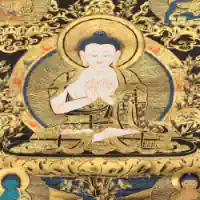
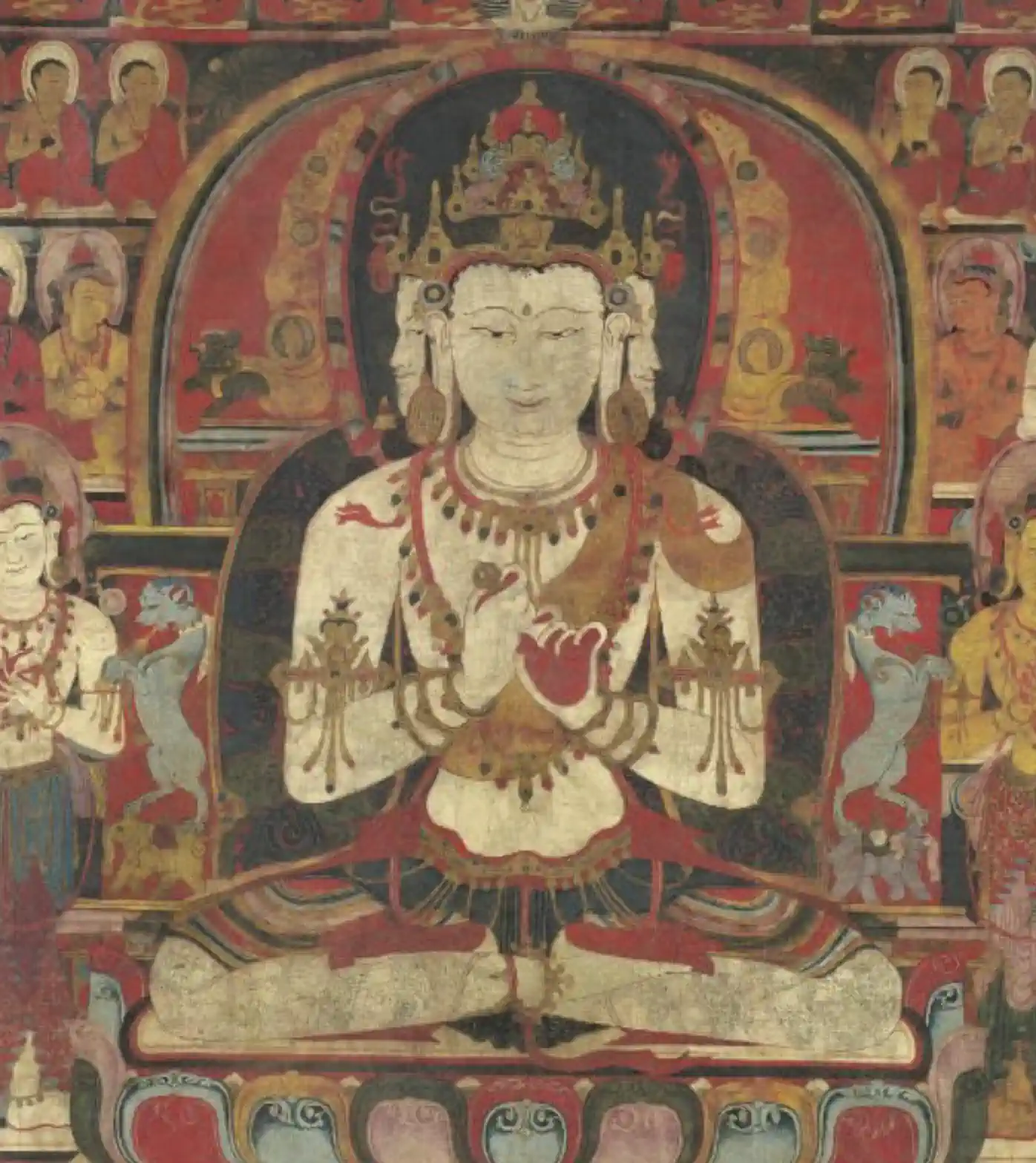
From the Buddha family, Vairocana the colour of white is resplendent Buddha, is central (though sometimes in the East e.g. in Tantra), sometimes seen as blue light. White energy is associated with the element of space. This energy makes us long for transcendence a larger perspective untroubled by ordinary worldly tribulations.
The Vairocana Buddha has a method of transport or throne represented as a lion or a pair of lions, or a dragon which scare away poisons and wrong views, delusion, ignorance, confusion, and bewilderment in relation to ending suffering.
Vairocana symbolizes all-pervasive wisdom (Suvisuddha dharma dhatu jnana) or the wisdom of suchness (tathata-jnana) free from all kinds of obscuration and often holds a wheel a bell and a vajra. i.e. knowledge, he represents Rupa (form) from the five aggregates or skandha.
The Ghanta or bell and the vajra or dorje never separate. Holding the Dorje in the right hand symbolically connects to the Buddhas wisdom.
In terms of the representing Mudra, he holds his hand against his chest with the tips of thumb and forefinger of each hand joined displaying Bodhyanga Vehicle mudra known as the Dharmachakraparvartana Mudra.
He comes from a family which represents eye consciousness.
His first face out of four looks to the east when known as Vajradhatu.
The Vairocana buddha has a seed syllable of DRUM which purifies ignorance or a white Om which corresponds to the aspect of body located at the crown chakra.
The consort of Vairocana is Akasadhatvisvari or Dharmadhatvishvari who is also white in colour and the related Bodhisattva is Samantabhadra, and Cittavajrī (Diamond mind) can be the attendant.
The wrathful version of Vairocana is Acala or Acalanātha.
The aggregate of consciousness is a key constituent element of a person’s self, belonging to the mental aspect. When the aggregate of consciousness is pure, it manifests as Buddha Vairocana.
May the Bhagavān Vairocana lead me.
May the Divine Mother of Infinite Space be my rearguard.
May him lead me safely across the fearful ambush of the Bardo.
May he place me in the state of the All-Perfect Buddhahood.
Om Vairocana Hum!
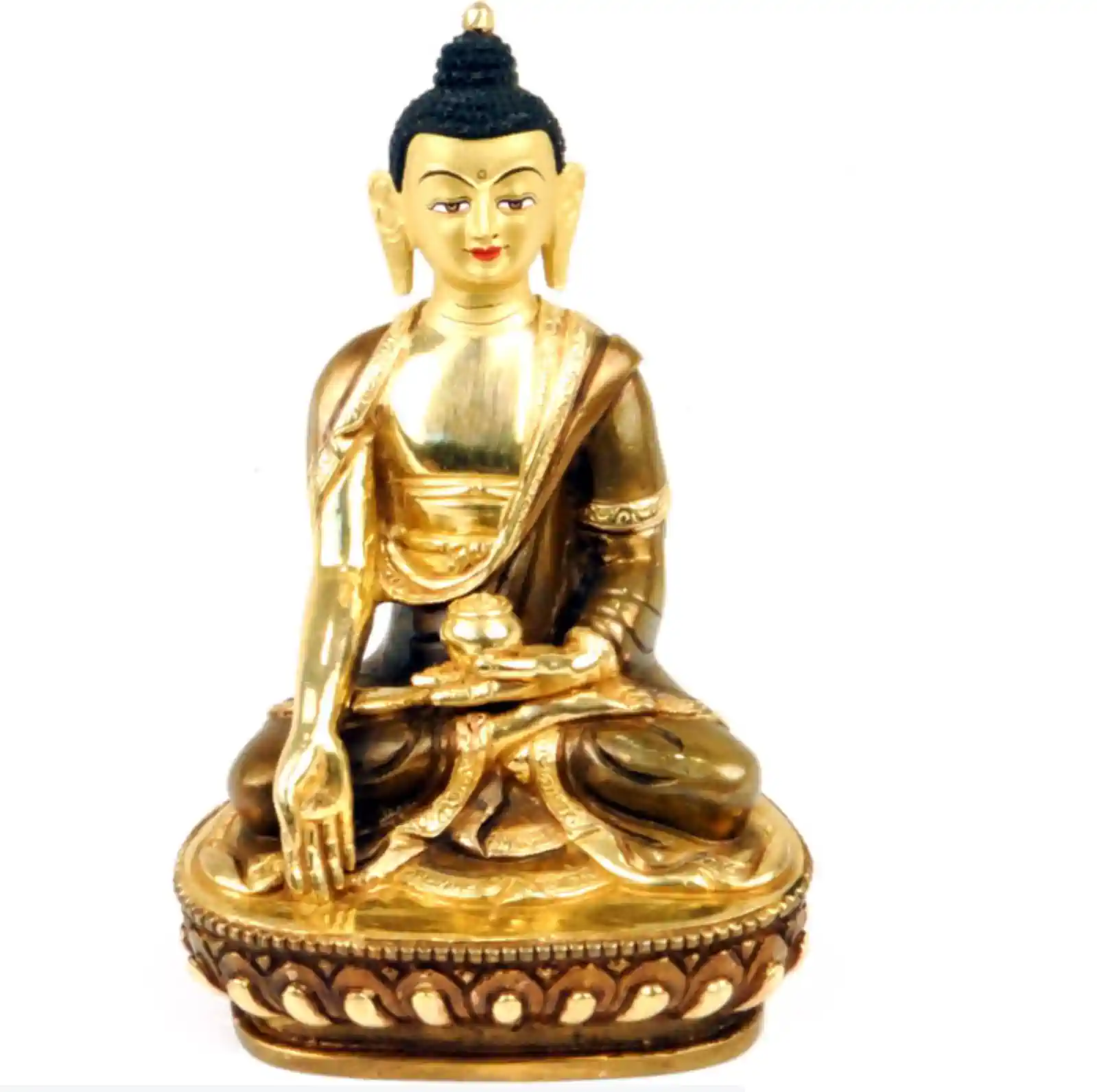
From the Vajra family Akṣobhya, the immovable, steadfast, unshakeable, Imperturbable, immutable one, has a method of transport or throne represented as the elephant, and fosters compassion in abundance.
Akṣobhya is represented by the color of blue, sometimes seen as white light, this color is linked with the element of water and makes us long for safety and control through understanding, which allows us to make the right decisions and maintain order.
Akṣobhya is often placed to the fragrant East (Abhirati pure land) of a place (though sometimes in the center, e.g. with Tantra).
He comes from a family which represents body consciousness and touch.
Akṣobhya Buddha symbolizes Mirror like Wisdom (Akasha or adarsa jnana), which means the wisdom like space, all pervasive, without limit or characteristics and free from aversion (dislike) and and is the manifestation of the purified aggregate of form or matter.
Akṣobhya Buddha is also the essence of a purified form of hatred or anger, one of the five poisons and often holds a vajra in his right hand and a bell in his left.
In terms of a representing mudra he exhibits the earth-touching gesture known as Bhu Sparsa or Bhumisparsha mudra.
Akṣobhya Buddha has a female consort Lochani (Locana) or Buddhalochana the lotus eyed one, who illuminates the three loka, or worlds of Svarga, Martya and Patala.
The Akṣobhya Buddha has a seed syllable of HUNG and purifies greed or a blue Hum, which corresponds to the aspect of mind located at the heart chakra.
Akṣobhya is related to the Bodhisattva Vajrapani, and the wrathful form of Akṣobhya is Trailokyavijaya.
He may appear named as Vajra-Sattva or Vajrasattva may sit to the East near the Akshobhya Buddha.
May I be led by the Bhagavān Vajra-Sattva,
May the Divine Mother Māmakī be my rear-guard;
May I be led safely across the fearful ambush of the Bardo;
And may I be placed in the state of the All-perfect Buddhahood.
Om Akshobhya Hum !

From the Ratna family the Ratnasaṃbhava Buddha, the Buddha of the treasured appearance, is represented by the color yellow or gold and his name means Jewel born. Often placed to the happiness bathed South of a place where represented.
Energy associated with the color yellow is based on the element of earth, and the merit of Buddha, the energy makes us long for stability or security through abundance and a sense of being substantial, he is also said to manifest the purity of the aggregate of feeling or sensation and represents the awareness of sameness (samata-jnana).
He comes from a family which represents ear consciousness and the sense of hearing.
The Ratnasambhava Buddha has a method of transport or throne represented as a lion or a horse where you might see him supported by these horses, he is often seen holding a jewel (the Cintamani) jewel in his left hand kept on his lap, and a bell in his hand and is generally seated in crossed leg position.
Ratnasambhava Buddha (Buddha born from Jewel) symbolizes the wisdom of equality (Samatajnana, or equinamity) from the five wisdoms, which symbolises the pristine cognition of sameness and being free from pride.
Ratnasambhava Buddha belongs to the Buddha family of jewel or blessings therefore, his right hand posture is that of giving a blessing known as Varada Mudra.
The female consort of Ratnasambhava is Mamaki who is gifted with a great sense of smell, is all illuminating and loved by all and is depicted in light yellow and the related Bodhisattva is Ratnapani.
The Ratnasambhava buddha has a seed syllable of OM and purifies aversion and pride or a yellow Tram, which corresponds to the aspect of attributes located at the navel chakra.
The wrathful form of Ratnasambhava is Kundali.
May I be led by the Bhagavān Ratna-Sambhava;
May the Divine Mother, She-of-the-Buddha-Eye, be my rear-guard;
May I be led safely across the fearful ambush of the Bardo;
And may I be placed in the state of the All-Perfect Buddhahood.
Om Ratnasambhava Tram!
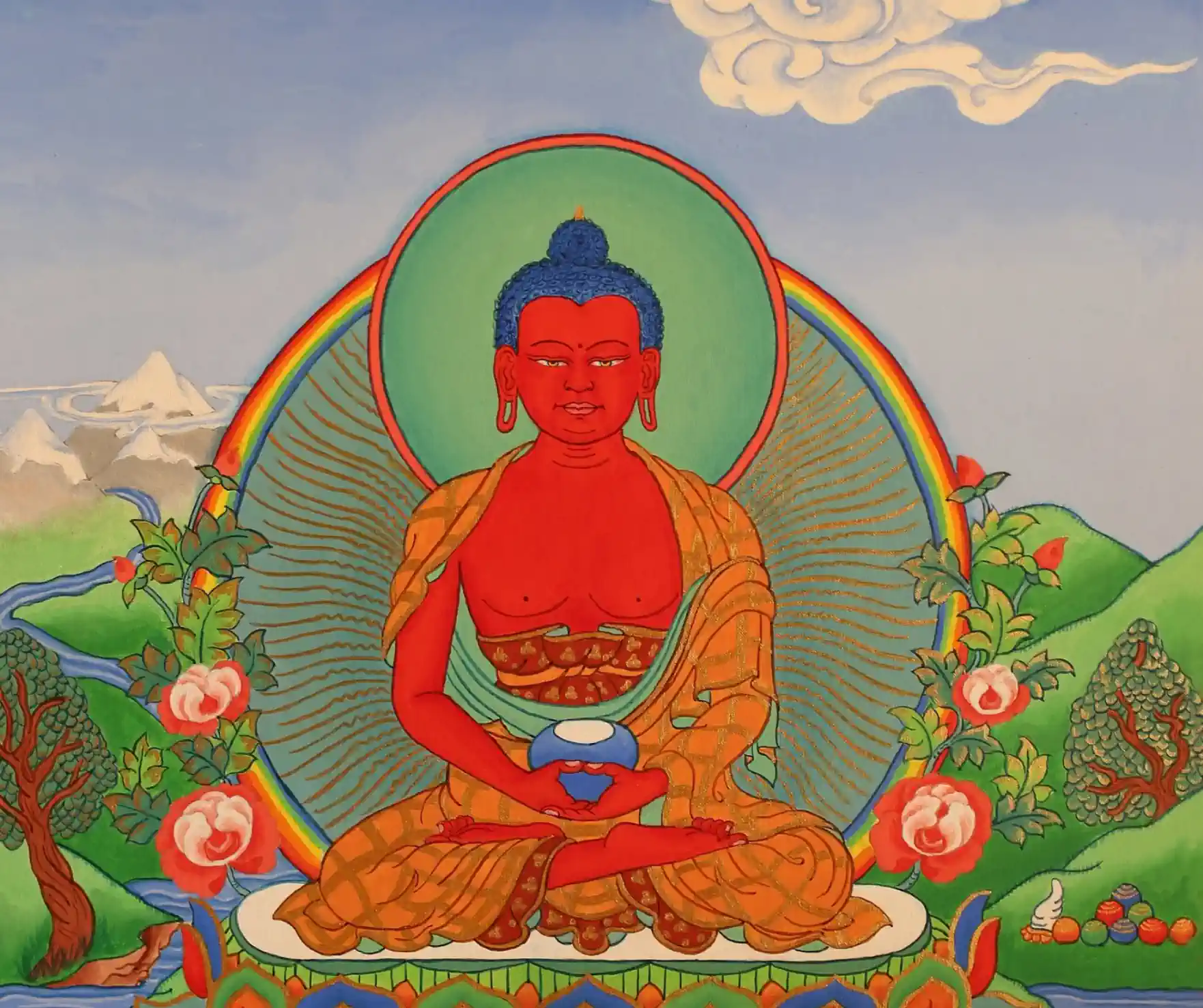
From the Padma family, Amitābha, the Buddha of limitless life, also representing the speech of the Buddha and is often placed to the West of a place where resides tranquillity and bliss.
Sometimes he may be seen with as a red flaming lotus signifying the Lotus Family of compassion and dharma speech.
He comes from a family which represents nose consciousness and the sense of smell.
He is one of the most compassionate of the pantheon of deity.
Represented by red color energy he is associated with the element of fire and the energy makes us long for intimacy with other beings, but also with everything we encounter and with life itself.
Amitābha Buddha, named the buddha of infinite light, or limitless light and represents the wisdom of discriminating awareness (Pratyavekshana jnana) from the five wisdoms, i.e. belief that existence is emptiness, he is purified from desire and greed.
Amitābha if often seen holding a lotus and a bell.
The method of transport or throne for Amitābha Buddha is a represented by the peacock.
Amitabha Buddha always exhibits a Dhyana Mudra.
The female consort of Amitabha Buddha is Pandura or Pandaravasini, who is gifted with the sense of taste and is the fourth of the Tara family and represents to purity of the element of fire.
The Amitābha Buddha has a seed syllable of HRI and purifies jealousy and envy or a red Hrih, which corresponds to the aspect of speech located at the throat chakra.
The consort of Pandaravasini or Pandara who is generally also red but of a lighter color and the related Bodhisattva is Avalokiteśvara.
The wrathful form of Amitābha is Yamāntaka.
He is named/represented as Amida in Japanese when in the diamond realm and Muryо̄ju when in the womb realm.
May I be led by the Bhagavān Amitābha, May the Divine Mother, She-of-White-Raiment, be my rear-guard;
May I be safely led across the dangerous ambush of the Bardo;
And may I be placed in the state of the All-Perfect Buddhahood.
Om, a-mee deh-wah, seh. (Sanskrit: Om, Amitabha hri.)
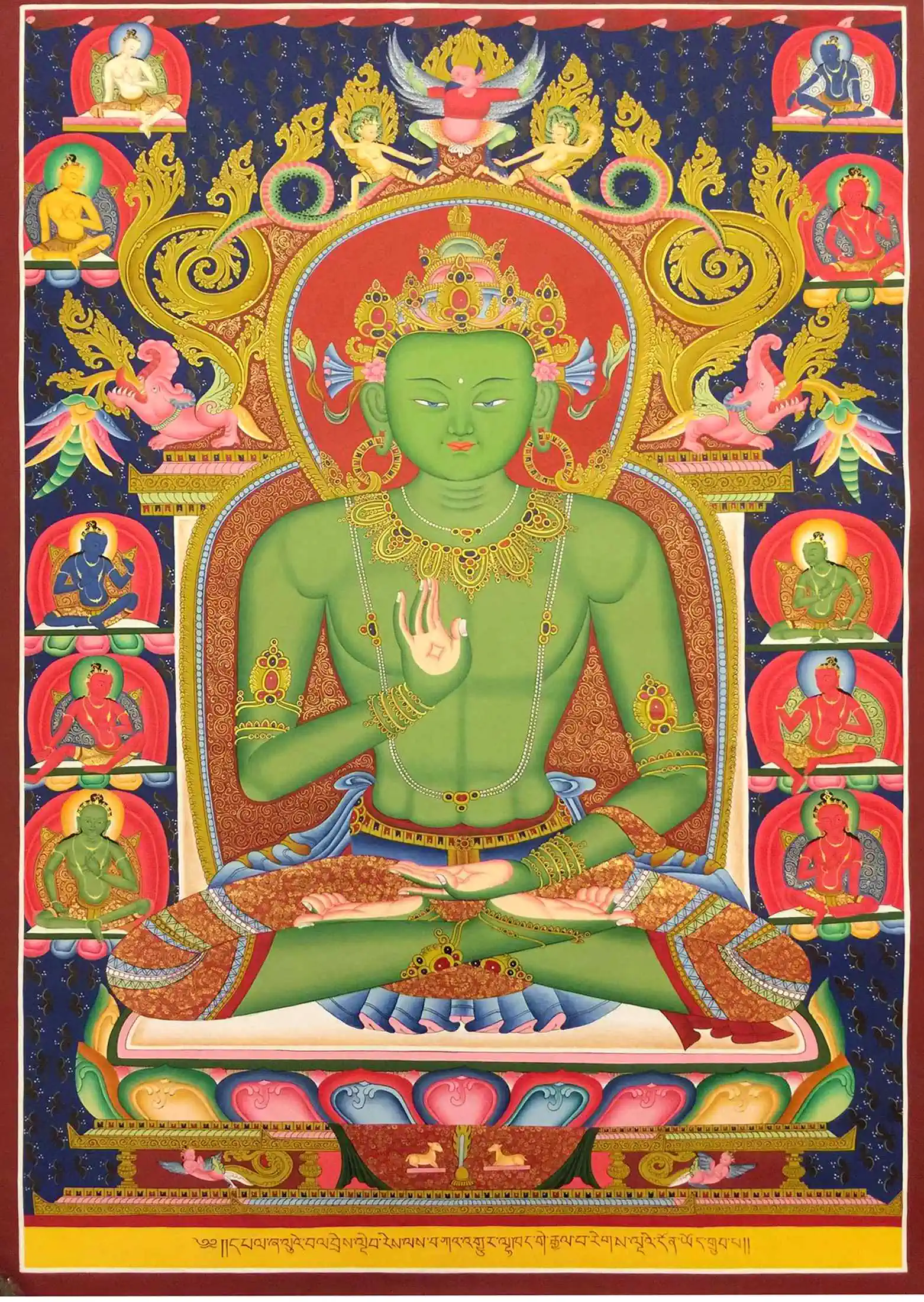
From the Karma family Amoghasiddhi, the infallible Buddha or Buddha of subtle hearing, is the color green, representing the all accomplishing activities of the Buddha and often is placed to the North of a place on a lotus throne or throne of a garuda where represented. Energy associated with the color green is linked to the element of air or wind. This energy makes us long to feel effective and capable by actively meeting challenges as they arise.
He comes from a family which represents tongue consciousness and the sense of taste.
The element of air is represented by the Amoghasiddhi Buddha and the method of transport is a represented as a mythical bird (a garuda), he is often seen holding a crossed or double vajra or a flaming sword and a bell in his hands.
Amoghsiddhi Buddha (the purified form of jealousy or envy) and represents the all accomplishing wisdom (Krityanusthan or krty-anusthana jnana) from the five wisdoms.
In terms of a representing mudra he exhibits Abhaya Mudra symbolizing fearlessness.
The Amoghasiddhi buddha has a seed syllable of HO and purifies attachment or a green A, which corresponds to the aspect of activities located at the sexual/secret chakra.
The consort of is Amoghasiddhi is Samayatara or Sarvanivarana, Vishkhambhin, Green Tara, Arya Tārā, or Shayama Tara, also known as Jetsun Dölma and the related Bodhisattva is Viśvapāni.
The wrathful form of Amoghasiddhi is Vajrayakṣa.
He is named/represented as Fukūjо̄ju in Japanese when in the diamond realm and Tenkuraion (Skt: Divyadundubhimeganirghosa) when in the womb realm.
May I be led by the Bhagavān Amogha-Siddhi;
May the Divine Mother, the Faithful Tārā, be my rear-guard;
May I be led safely across the dangerous ambush of the Bardo;
And may I be placed in the state of the All-Perfect Buddhahood.
Om Amoghasiddhi An!