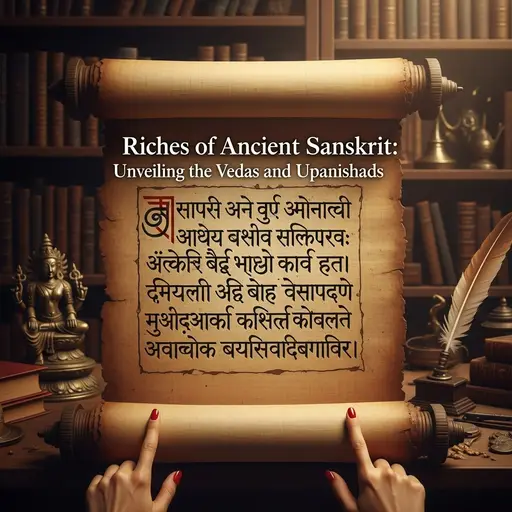
 

Riches of Ancient Sanskrit: Unveiling the Vedas and Upanishads. - List

  5.00/5.00 - (1 votes for article, provide comments and help us improve if required.)

Explore the profound wisdom and enduring legacy of foundational Sanskrit literary works.

Vedic texts and Upanishads in SanskritVedic texts and Upanishads in SanskritVedic texts and Upanishads in SanskritVedic texts and Upanishads in Sanskrit
Exploring the profound philosophical and cultural heritage of Sanskrit literature.

Dive into the timeless expanse of Sanskrit literature, a treasure trove of ancient Indian thought. This list illuminates key aspects of the Vedas and Upanishads, foundational texts that have shaped philosophy, spirituality, and culture for millennia. Discover the linguistic intricacies and philosophical depth that continue to inspire.

Riches of Ancient Sanskrit: Unveiling the Vedas and Upanishads.

1. The Rigveda: Hymns of Praise

The Rigveda is the oldest extant Vedic Sanskrit text. It comprises ten books and over 1,000 hymns (suktas), primarily in the Anushtubh meter, addressed to various deities like Agni (fire), Indra (king of gods), and Soma (a ritual drink). These hymns offer insights into early Indo-Aryan cosmology, rituals, and daily life, serving as a cornerstone of Hindu tradition and a marvel of ancient poetic expression.

2. The Upanishads: Philosophical Dialogues

The Upanishads, often referred to as Vedanta, are philosophical treatises that form the concluding part of the Vedas. Composed between 800 BCE and 200 BCE, they delve into profound concepts like Brahman (ultimate reality), Atman (self), karma, and moksha (liberation). Key Upanishads include the Brihadaranyaka, Chandogya, and Katha, offering profound meditative insights and metaphysical explorations that have influenced global thought.

3. Sanskrit's Proto-Indo-European Roots

Sanskrit is a Classical Indic language and a member of the Indo-Aryan subgroup of the Indo-Iranian branch of the Indo-European language family. Its sophisticated grammar, as codified by Pāṇini in his Ashtadhyayi around the 5th or 6th century BCE, is remarkably precise. This grammatical structure showcases deep linguistic connections to ancient languages like Greek, Latin, and Persian, illustrating a shared cultural and linguistic heritage.

4. The Mahabharata: Epic Narratives

The Mahabharata, one of the world's longest epic poems, attributed to the sage Vyasa, is a vast narrative encompassing war, dharma (righteousness), and human relationships. Its most famous part is the Bhagavad Gita, a philosophical dialogue between Prince Arjuna and Lord Krishna. The epic explores complex moral dilemmas and provides a rich tapestry of ancient Indian societal values and philosophical teachings.

5. The Ramayana: A Tale of Duty and Devotion

The Ramayana, primarily attributed to the sage Valmiki, is another epic poem detailing the life and adventures of Prince Rama. It's a narrative of dharma, loyalty, and devotion, illustrating the ideal king, son, and husband. The story's enduring popularity lies in its exploration of familial duties, the struggle between good and evil, and the concept of righteous living in ancient Indian society.

6. Panini's Ashtadhyayi: A Linguistic Masterpiece

Pāṇini's Ashtadhyayi, dating back to the 5th or 4th century BCE, is a definitive and comprehensive grammar of Sanskrit. It meticulously categorizes and explains the phonetic and grammatical rules of the language, comprising approximately 4,000 sutras (aphorisms). This monumental work set a standard for linguistic analysis that remains unparalleled even today and is crucial for understanding the structure of Vedic and Classical Sanskrit.

7. Kalidasa: The Shakespeare of India

Kalidasa, widely considered the greatest poet and playwright in Sanskrit literature, flourished in the Gupta period (around 3rd to 5th centuries CE). His celebrated works include the poetic dramas Abhijnanashakuntalam (The Recognition of Shakuntala) and Meghaduta (The Cloud Messenger). His mastery of language, emotional depth, and elegant descriptions of nature have earned him international acclaim.

Synonyms/tags: Sanskrit literature, Vedas, Upanishads, Rigveda meaning, Sanskrit grammar, epic poems India, Kalidasa works, Mahabharata philosophy


Or, per your interest, look at other related links;

  Ever wondered how ancient Indian poets created verses that flowed ...
  Exploring the Legacy of C. R. Devadhar: Unveiling the Depths of ...

Or, why not search for other related lists on our site;

Or, watch a related video from YouTube by clicking below;


This list was published by Here There, Everywhere and is a printable check-list; To print, hold down the key marked "ctrl", and whilst holding that down, press the "p" key.
This is a downloadable list, select here, if you would like to download the Riches of Ancient Sanskrit: Unveiling the Vedas and Upanishads. - List as an excel or .csv file. Or find the print function on your browser (top right, three dots, print) and print to a pdf printer if you would like to download as a pdf file, or print to a pdf file.

If you are interested in advertising with us reach out via the contact page below. If you would like to share viewers, and your site is related with great content, then feel free to use the code below on your site then reach out via our contact page and we will look for a place to mention you.


Otherwise, suggest improvements, request additional items, report typos, errors or misspellings, ask us questions or just say hello via the comments here below, we are always pleased to hear from you.

Comments HistoryBe a pioneer and write the first comment.

Note: Current average rating of 5.00 based on 1 reviews and ratings. (1-Low, 5-High)

Note: Comments and ratings help this site get better; if you see something missing, see something wrong, have a question, or want to suggest something to improve then comment below and join the dialogue;

Comments


Looking for something else? Then search the rest of the internet here. If you do like what you see then come back sometime and create your own checklist here. If the item does not have a checkbox next to it, its probably a folder which you can open by clicking. If there are actions listed against an item on the right hand side you can visit websites, download as excel/csv for xls, or create an ical calendar entry.

If you found this page useful, share it, or like us using the buttons on the bottom right, it helps us to improve.

This webpage with information about Riches of Ancient Sanskrit: Unveiling the Vedas and Upanishads. has the following attributes;
The list was authored by .

« Go look for more free lists & checklists