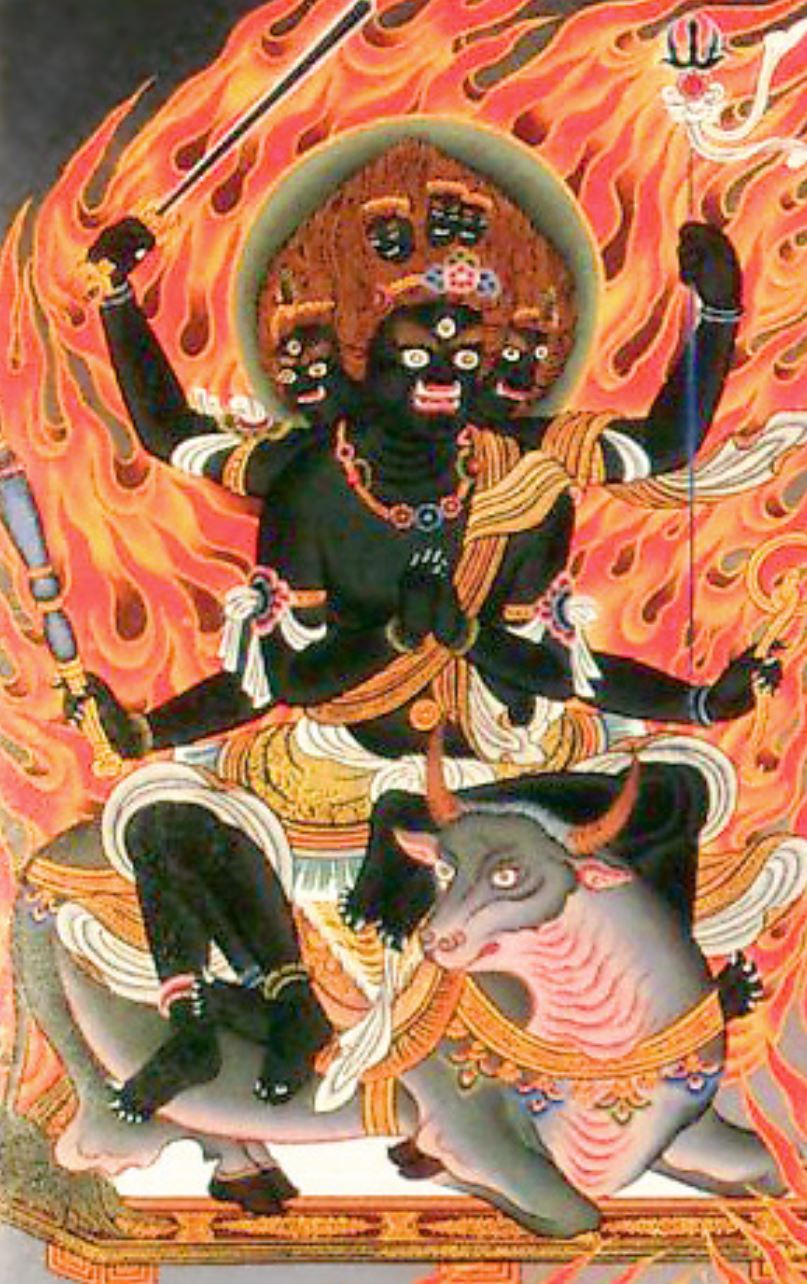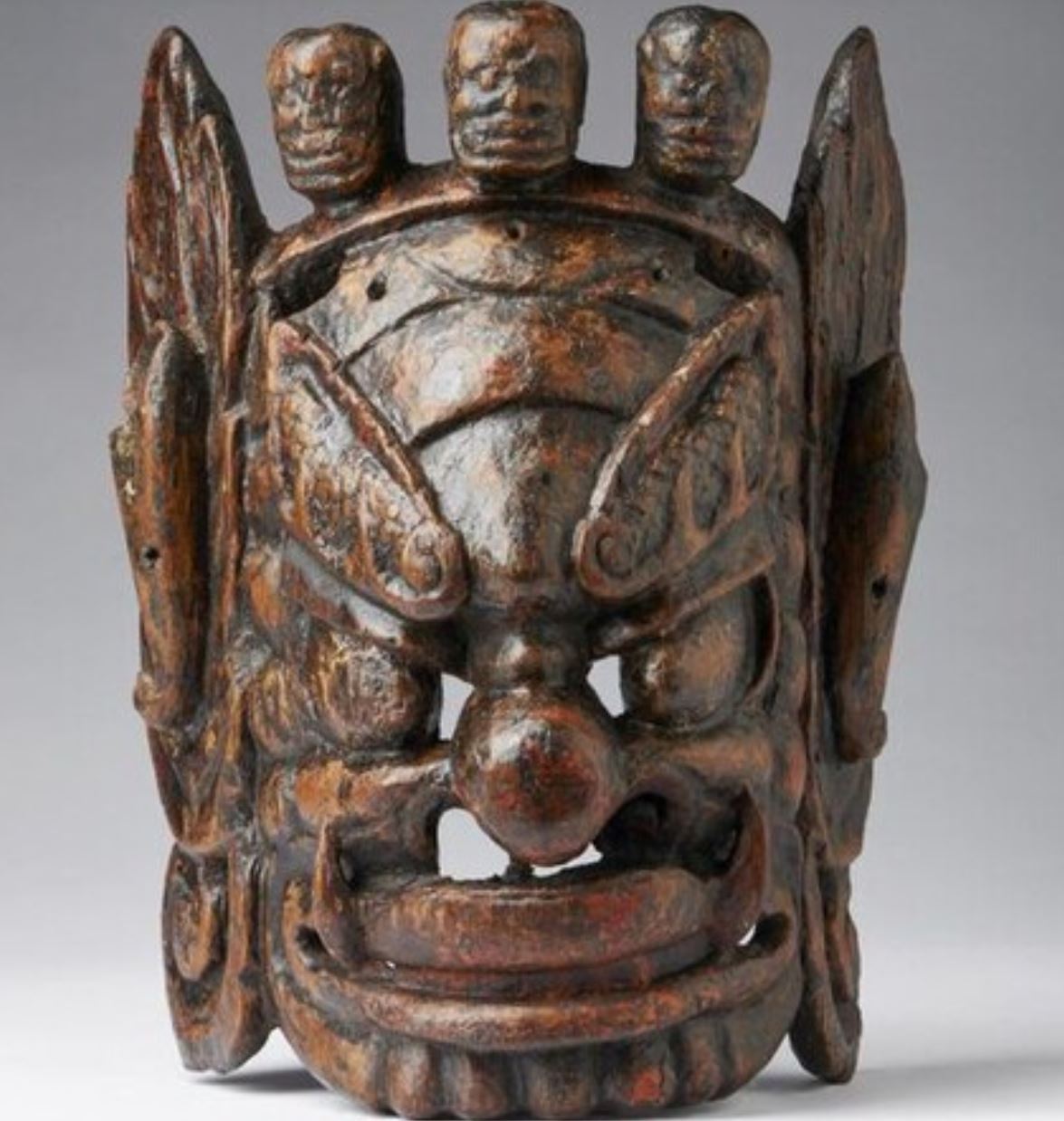
01. Lha-mo, Śrī-devī, Palden Lhamo or Kāla-devī.
Palden Lhamo or the glorious goddess is the fierce city goddess of Lhasa, protector of Buddhist governments and Tibet and the only feminine divinity in the group .
Palden Lhamo is the consort of Mahakala. Her Sanskrit name is Shri Devi (or she is a wrathful emanation of), she was married to an evil king of Lanka. She tried to reform her husband but failed. Further, their son was being raised to be the destroyer of Buddhism. One day while the king was away, she killed her son, drank his blood and ate his flesh. She rode away, surrounded by wisdom fire, on a horse or mule saddled with her son's flayed skin though a sea of blood.
The king shot a poisoned arrow after Palden Lhamo. The arrow struck her horse. Palden Lhamo healed the horse, and the wound became an eye.
She is dark blue and has one face with three eyes and wears a sun at her navel and a moon at her crown, and over her is a peacock umbrella. She is variously depicted, but her most common forms are two-armed and four-armed. There is also a system of divination by dice associated with her.
She is sometimes considered as equivalent to Sarasvati or Tara.
02. Tshangs-pa Dkar-po or Sita-Brahmā.
Tshangspa is the Tibetan name for the Hindu creator god Brahma and is the White Brahmā. The Tibetan Tshangspa is not a creator god, however, but more of a warrior god. He usually is pictured mounted on a white horse and waving a sword.
In one version of his legend, Tshangspa travelled the earth on a murderous rampage. One day he attempted to assault a sleeping goddess, who awoke and struck him in the thigh, crippling him. The goddess's blow transformed him into a protector of the dharma.
03. Beg-tse or Begtse.
Begtse or hidden sheet of mail is a war god who emerged in the 16th century, making him the most recent dharmapala. His legend is woven together with Tibetan history:
Sonam Gyatso, the Third Dalai Lama, was called from Tibet to Mongolia to convert the warlord Altan Khan to Buddhism. Begtse confronted the Dalai Lama to stop him. But the Dalai Lama transformed himself into the Bodhisattva Avalokiteshvara. Witnessing this miracle, Begtse became a Buddhist and a protector of the Dharma.
In Tibetan art, Begtse wears armor and Mongolian boots. Often he has a sword in one hand and the heart of the enemy in the other.
04. Yama or Gshin-rje.
The god of death, who may be accompanied by his sister, Yamī.
Yama is lord of the Hell Realm. He represents death.
In legend, he was a holy man meditating in a cave when robbers entered the cave with a stolen bull and cut off the head of the bull. When they realized the holy man had seen them, the robbers cut off his head also. The holy man put on the head of the bull and assumed the terrible form of Yama. He killed the robbers, drank their blood, and threatened all of Tibet. Then Manjushri, Bodhisattva of Wisdom, manifested as Yamantaka and defeated Yama. Yama became a protector of Buddhism.
In art, Yama is most familiar as the being holding the Bhava Chakra (the wheel of life) in his claws.
05. Kubera, or Vaiśravaṇa or Rnam-thos-sras.
The god of wealth and the only one among the eight who is never represented in a fierce form.
He who also hears everything has sometimes a symbol of an umbrella and is orientated and is the guardian of the north.
One of the Four Great Kings, he presides over the northern quarter and rules over the yakṣas. He is similar or equivalent to Jambhala.
Om, jum-bah-lah, chah-lan chah-nah-yeh, so-ha. (Sanskrit: Om, Janibhala dsalendraye svaha.)
Mahakala or the Great Solitary One has body blue-black in colour, dark like the end of time, with three round red eyes, quickly glancing, a radiant face with bared fangs, tongue lolling, flames for eyebrows and a beard of hooks.
Mahakala might be seen with and two, four arms or six arms, he is the wrathful form of the gentle and compassionate Avalokiteshvara Bodhisattva.
When he has six arms, he is called Shadbhuja or mGon po phyag drug pa and his arms signify the successful completion of the six perfections (shad-paramita).
When he has four arms, he is called Chatur-bhuja or mGon po phyag bzhi pa and represents the represent the four karmas.
Sometimes he is called protector of the tents, and there is a white version of Mahakala named Shad-bhuja Sita or mGon po yid bzhin nor bu (his attributes are the sword, the trident and the scull cup). Mahakala is charged with the tasks of pacifying hindrances; enriching life, virtue, and wisdom; attracting people to Buddhism; and destroying confusion and ignorance.
Mahākāla can often be seen with a half vajra adorning the crown of the head along with a snake tied in the hair.
Often standing in the center of a lotus he also sometimes holds the ritual knife (kartrika) and skull cup (kapala), and a ritual baton (gandi) maybe resting in the crooks of his arms (used to reprimand, underscoring the role of Mahakala as the god of justice, who governs the oath and watches over the fulfilment of vows and promises), he wears a tiger skin around his waist.
Often, he wears a crown bearing five or six skulls sometimes with a lengthy garland of severed heads and a white scarf, the five skulls represent the transmutation of the five negative afflictions of human nature into positive virtues.
His feet are usually pressing heavily on a corpse, with which Mahakala, as the great Lord of Death, is symbolically associated.
Om Shri Mahakala Hum Phat.
Om Mahakalaya Soha.
Om Benza Nara Trim Trim Hung Hung Phet Phet Soha.

Hayagrīva, literally, having the neck of a horse, is an important deity who originated as a yaksha attendant or wrathful from of Avalokiteśvara, Avalokiteśvara is connected with the enlightened mind, but in this manifestation, as Hayagriva, he represents as enlightened speech and also manifests the purity of the body.
He is associated with the Padma Buddha Family where the Buddha is Amitabha, he is sometimes said to be the wrathful Heruka emanation of Amitabha.
Hayagrīva is also identified as a Wisdom King in Vajrayana Buddhism, his special abilities include his special ability is to cure diseases.
It is said Hayagriva is the wrathful form of Vajrasattva, who assumes the form Avalokiteshvara and turns into Hayagriva in order to defeat a powerful demon.
Hayagriva is usually represented with one face, two arms and two legs, and a horse head above his head, he is wrathful and has three glaring eyes, and fangs. He holds the a pose of a warrior and holds a sword raised threateningly in his right hand (poised to cut through delusion), his left hand he raises in a threatening gesture, and he usually has snake ornaments. This terrifying aspect expresses compassion’s fierce determination to help us overcome inner egotism and outer obstructions.
He has the power to cure diseases (skin diseases in particular) and is a protector of horses. He wears a horse's head in his headdress and frightens demons by neighing like a horse.
In other representations, Hayagriva has six hands, four or eight legs and three large eyes. in these versions, on the top of Hayagriva’s head are three small green horse heads. The legs stand on two corpses, symbolizing the mundane attachments that should be destroyed.
Om HRIH Padman tatro vajra Krodha Hayagriva Hulu Hulu Hum Phat.

08. Yamāntaka, Yamari, Jikché, Vajrabhairava or Gshin-rje-gshed.
Yamantaka, known as buffalo head is the conqueror of Yama, the defeater of death and him a protector of the Dharma, he is said to descend from Akshobhya.
Since Yama represents death, Yamantaka represents that which is stronger than death.
When representing the enlightened body he is known as Mañjushri Body (the Bodhisattva of Wisdom). Although usually Mañjushri represents enlightened speech, in the Kagyé he represents enlightened body. Having the nature of Mañjushri this deity appears in wrathful form and is known as Yamantaka. This is the same as the yidam deity known as Vajrabhairava, on which the followers of the Riwo Ganden tradition (i.e. the Gelugpas) meditate.
It is said the followers of the Buddha-dharma appealed to the Great Bodhisattva, Manjushri, for help in destroying death, having both wisdom and compassion, as well as superior knowledge, Manjushri used like to conquer like by assuming a fierce bull-headed form himself and put an end to the furious and mindless predation of that particular version of Yama, the Lord of Death.
In the Kagyu school Manjushri as his manifestation of Yamantaka is shown as black or midnight blue.
Mañjushri is associated with east and his wrathful deity of Yamāntaka is depicted when depicted in the west.
In art, Yamantaka usually is shown standing or riding a bull that is trampling Yama.
Yamāntaka presides over the East and is one of the popular deities of the Buddhist pantheon Somtimes Yamāntaka is also known as Yamāri who is often endowed with two forms known as Kṛṣṇa-Yamāri and Rakta-Yamāri.