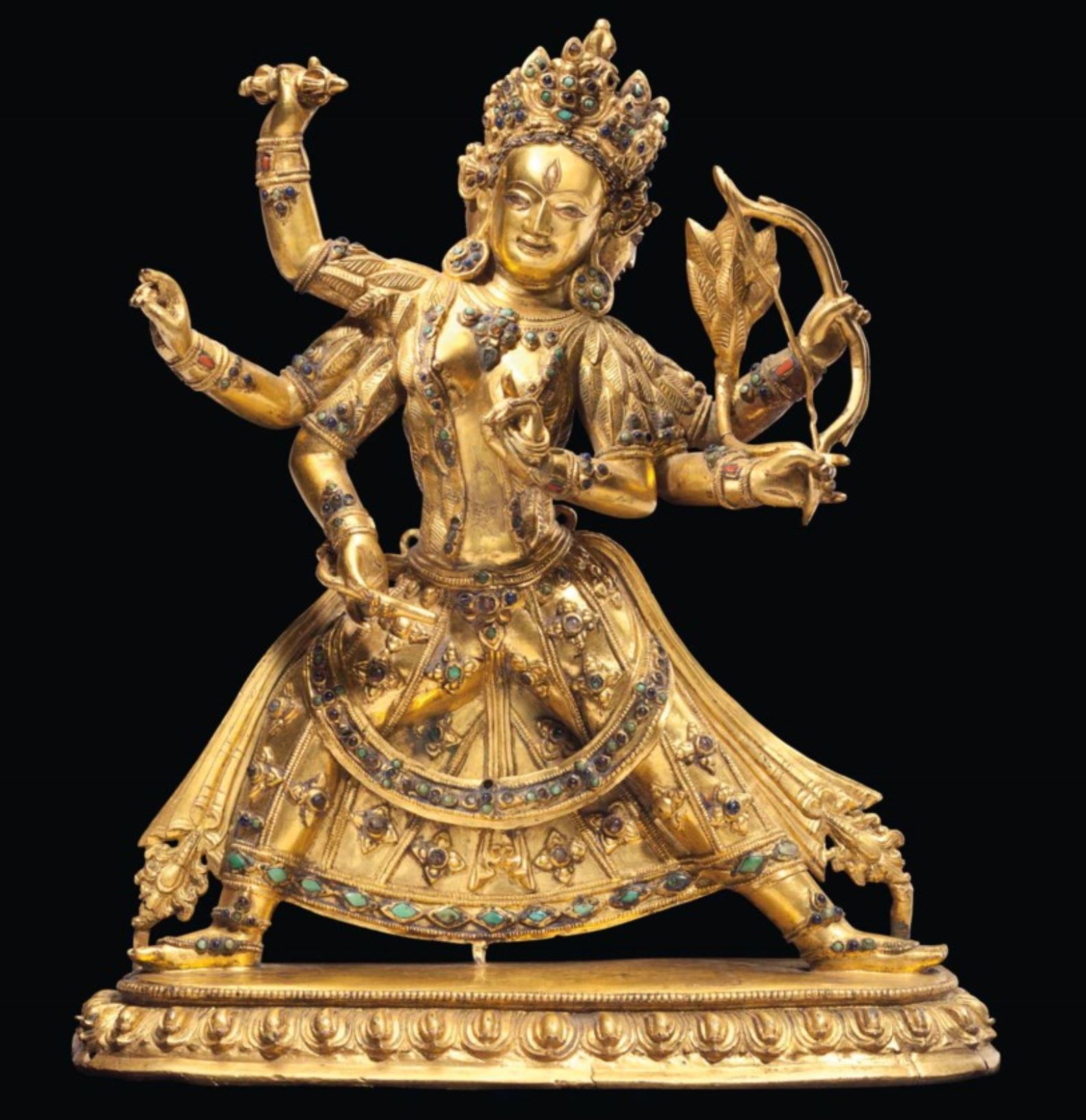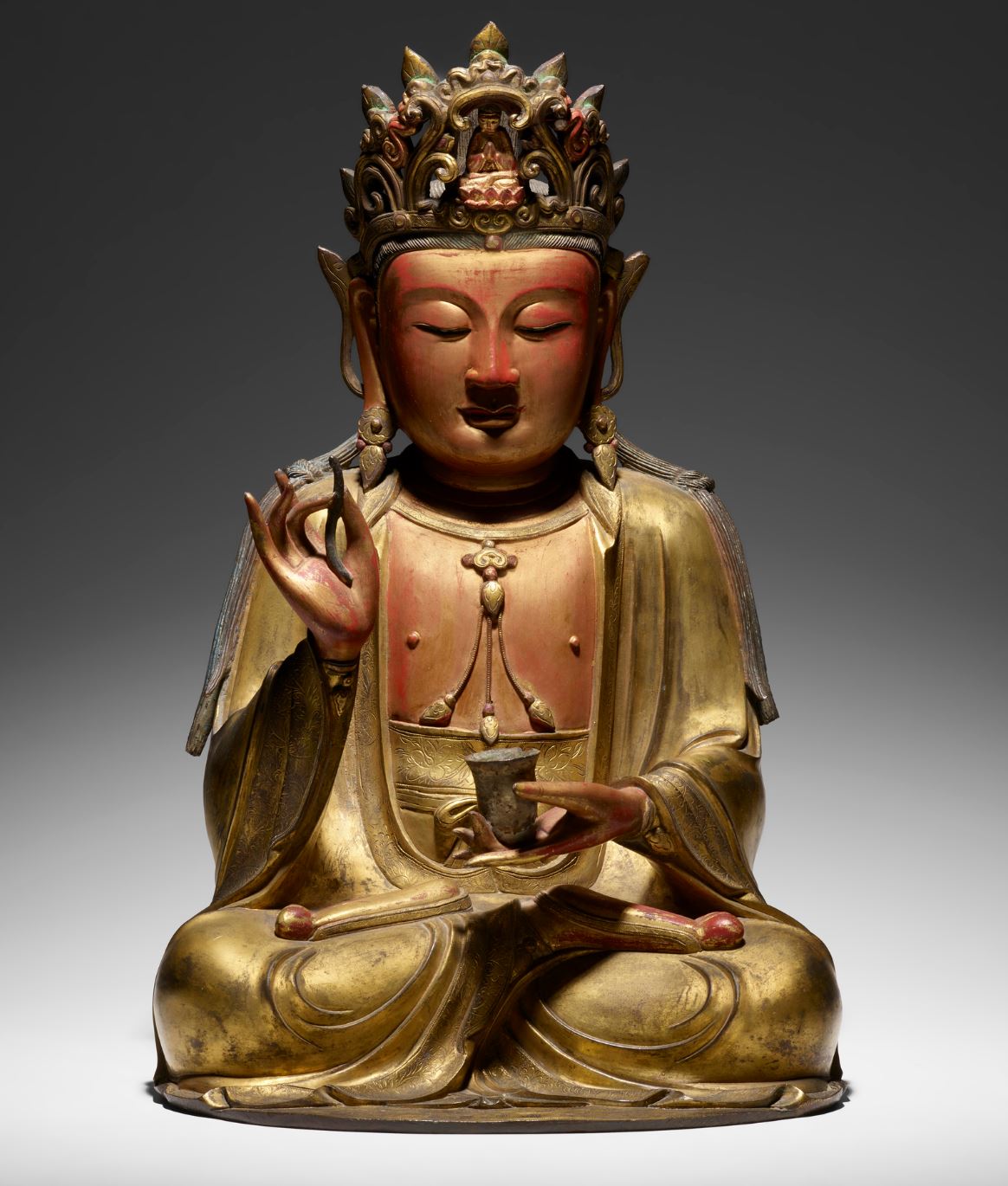
01. Sarasvati, Sarasvatī or Saraswati.
Sarasvati is in many ways a counterpart to Manjushri, the male Bodhisattva of discriminating wisdom. Sarasvati is a peaceful yidam who holds a vina (a sitar-like lute) on her lap, she also sometimes holds a text. She is often snowy white coloured with a pleasing countenance and with one face, two eyes, and two arms. There is also a Hindu deity named Sarasvati with near-identical attributes.
She is sometimes connected to Palden Lhamo, who may be regarded as Sarasvati in wrathful form and is sometimes called the daughter of the swan.
In the tradition of Shakyashri Bhadra and Sakya Pandita Kunga Gyaltsen, in the north-west is red Saraswati, peaceful, with three faces, red, blue and white. The first pair of her six hands, holding a curved knife, and skull, embraces the father similar to herself. The two remaining right hands hold a lotus and a sword, and the left two a jewel and a wheel.
Goddess of wisdom, learning, eloquence, knowledge, education, music, poetry, the arts, and culture, the consort of Manjushri, she is often identifiable by her plain white garment, and her pipa, veena or lute which is a stringed musical instrument.
In Tibet she is known as Yangchen Lhamo or Yangchenma, pron. Yanzhima.
In the expansive lotus-garden of speech of all the conquerors,
With 100,000 melodious blooms of holy Dharma,
You are a singing swan that shines as bright as moonlight,
May you now enjoy the vast lake of my mind.
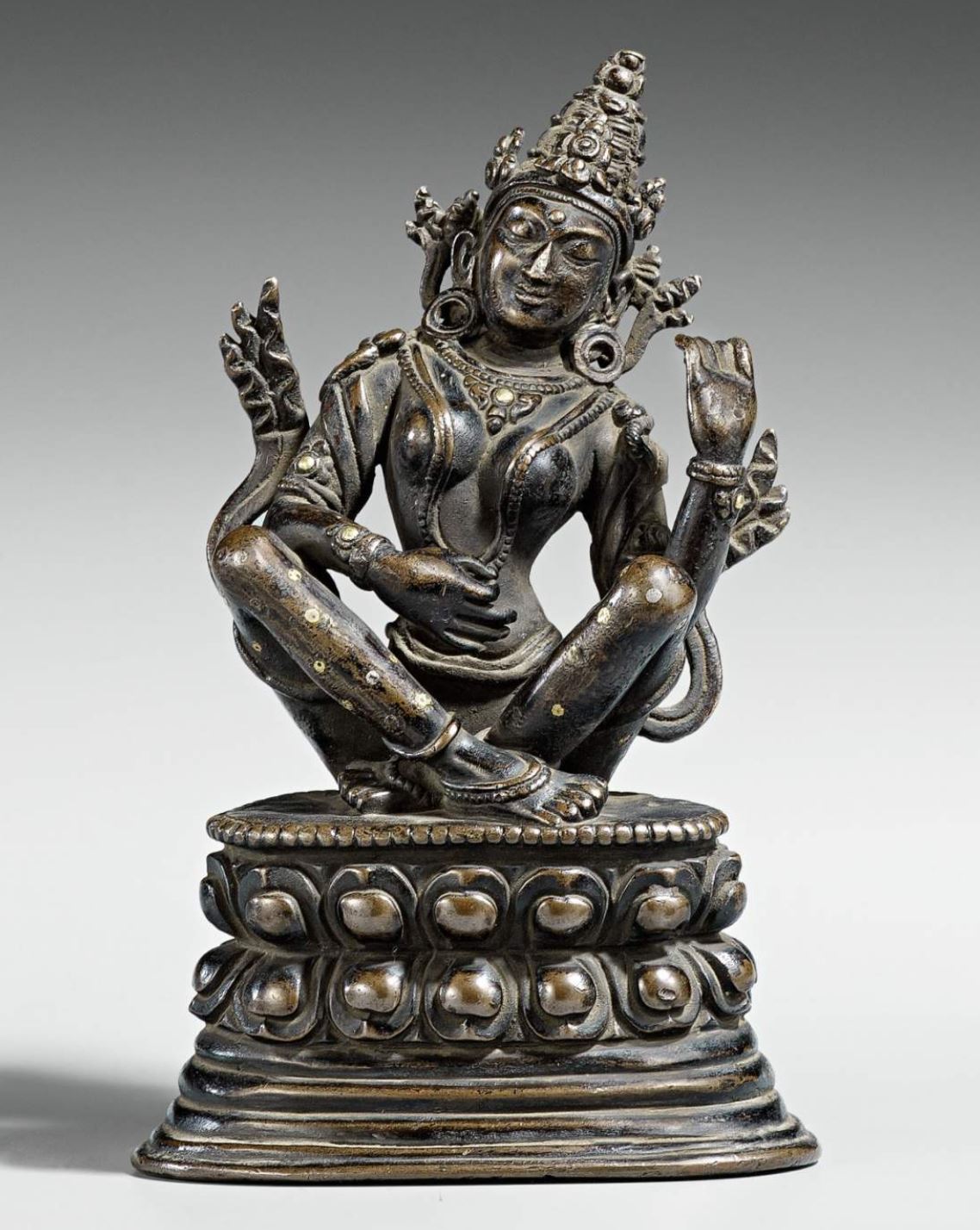
02. Chunda, Cundi or Cunda, Tibettan: Tsunda, Chinese: Chun-ti
Mudra: dhydna (meditation).
Symbols: kalasa (vase), mala (rosary), pustaka (book).
Colour: red (or white).
Possible blessings: Pregnancy, Safe child birth, Guardian, Purification.
The goddess Cunda has two representations one with four arms and another with sixteen. She may even have eighteen, for there is a statue of Cunda in the courtyard of the house of the Mahant of Bodh-Gaya with eighteen arms.
According to the sadhana, the form with four arms is red, and the upper hands hold the rosary and book, while the lower are in 'meditation' mudra and hold the vase. She has a sweet expression.
Cunda with sixteen arms is warlike in appearance, but besides the sword, hatchet, bow, arrow, and thunderbolt, she carries a rosary, lotus, a vase and one of her hands may be in 'charity' mudra, while the original pair of hands are in 'teaching' mudra.
Maybe, once based on the goddess Durga, the princess of Lord Shiva in Hinduism.
Om, dze-lee dzu-lee zhun-teh, so-ha. (Sanskrit: Om, cale cule cunde svaha.)
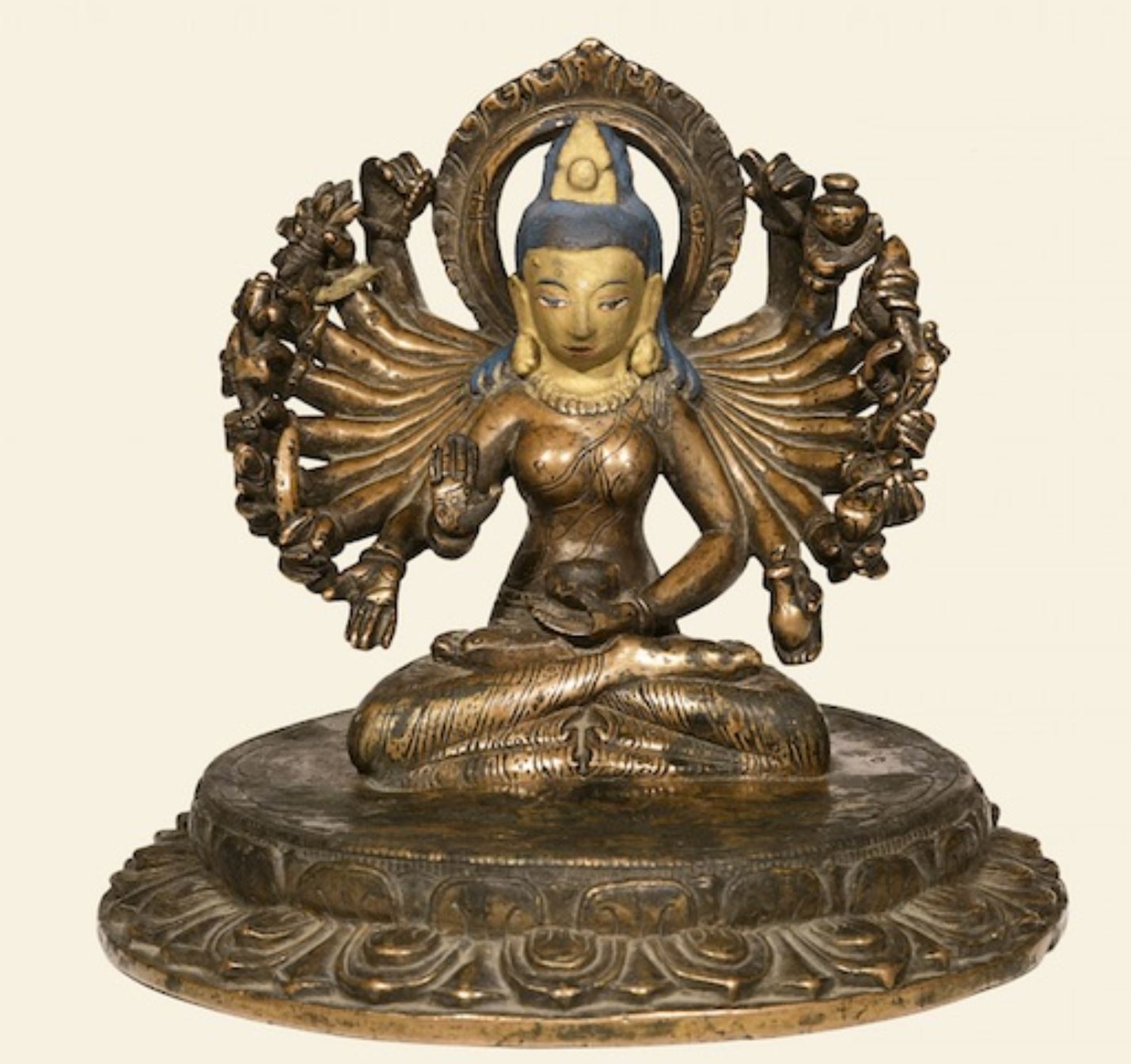
03. White Tara, Sitatara or Sgrol-dkar.
The white Tara symbolizes perfect purity, is sometimes called the mother of all Buddha and is believed to represent transcendent wisdom, which secures everlasting bliss to its possessor.
She is white and is seen with legs locked.
Believed to be incarnate in the Chinese princess Wen-ch'eng, daughter of the emperor of China;
The white Tara was born from a tear which fell from the right eye, and the green Tara from a tear from the left eye of Avalokitesvara and so is the Consort of Avalokitesvara and is seen on his right standing.
Ushnishavijaya is often shown in a triumvirate with the other two principal long-life deities, red (male) Amitayus and White Tara.
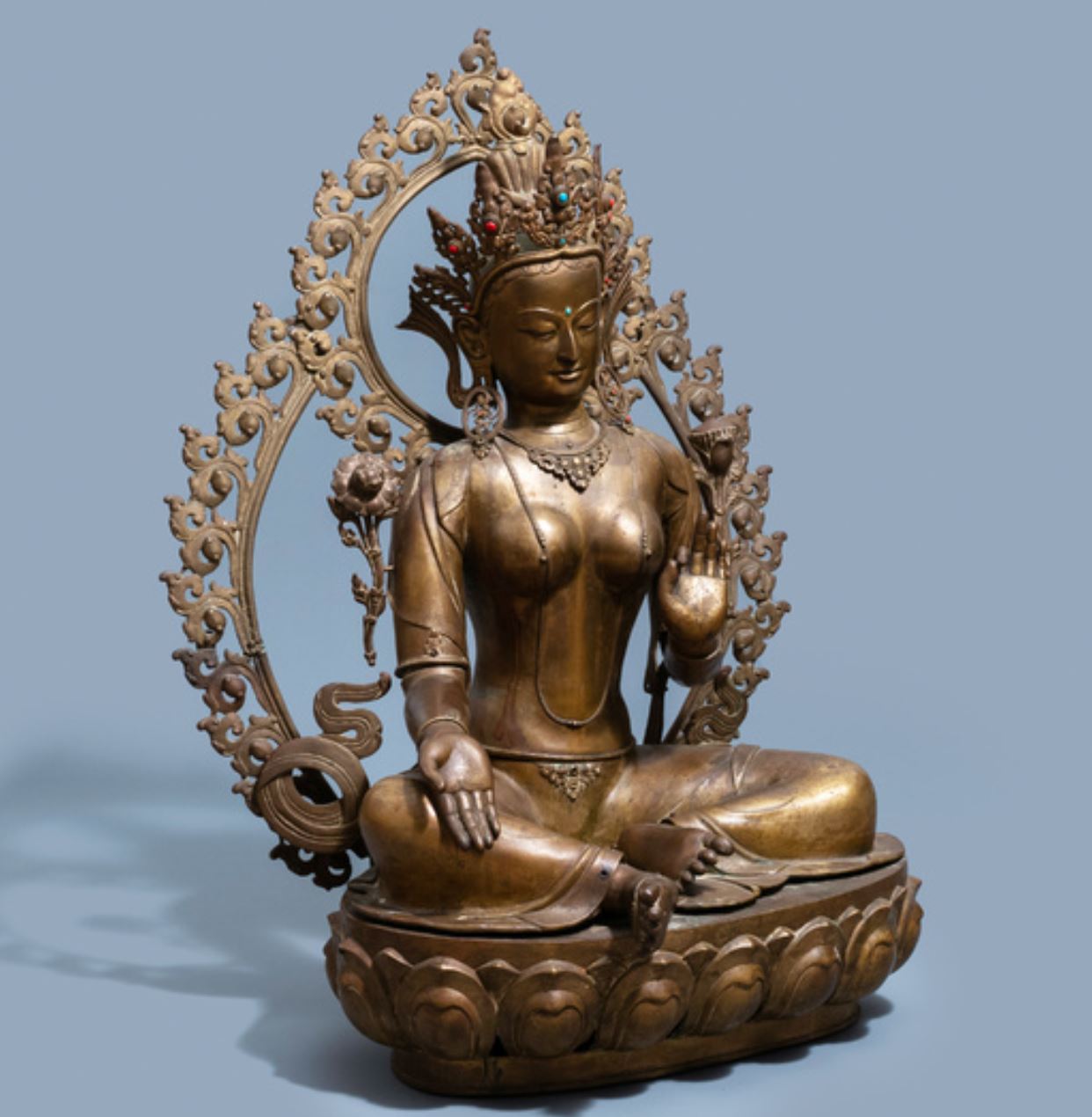
04. Khadiravani Tara.
Khadiravani-Tara is a form of the yellow Tara. She is represented seated, with the right leg pendent, but the foot is not supported by a small lotus asana like the green Tara. The right hand is in 'charity' mudra and holds the stem of a full-blown lotus-flower. The left hand is in 'argument' mudra and holds the stem of an utpala. She may be accompanied by the goddesses Marici and Ekajata.
Said to descend from Amoghasiddhi.
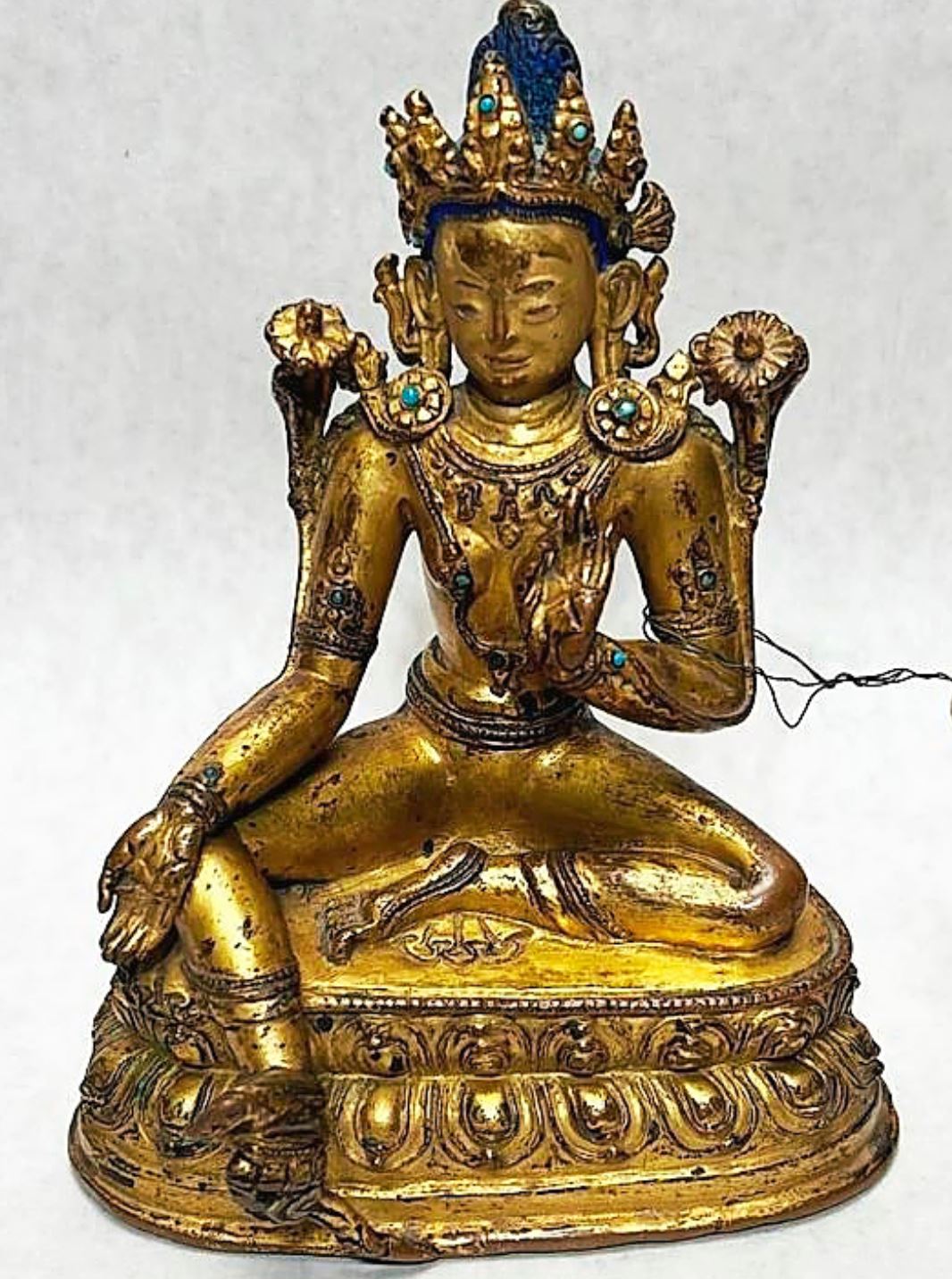
05. Sitatapatra.
Sitatapatra or white parasol (she herself is represented in white) is a form of Tara and may be seen holding one or two parasols (With the right she holds a parasol at her breast, with the left another on her knee), has third eye (she can also have one eye in the palm of each hand and the sole of each foot, showing that she watches and protects sentient beings). with sometimes three or four heads (blue, white and red, one at the rear) and have eight arms. The other hands when present hold the wheel, bow, arrow, book, and lasso.
Sitatapatra is one of the titles of Avalokitesvara, but there is also a goddess, Sitatapatra, who is looked upon as a form of Tara, and has the rank of Bodhisattva. She may possibly be a feminine manifestation of the god of Misericordia, or the sakti of a special form of the Avalokitesvara.
She is believed to protect all true believers.
Her central faces are white (as is her body); her right faces are yellow, the faces at the rear of her body are red, and the left faces green; there is also a "tier" of blue faces at the top of her head. Her right hands hold wheels of the Dharma (dharmachakra) and her left hands hold arrows; one of her other left hands also holds aloft a white parasol which also symbolises her protection.
Sitatapatra is said to descend from Vairocana.
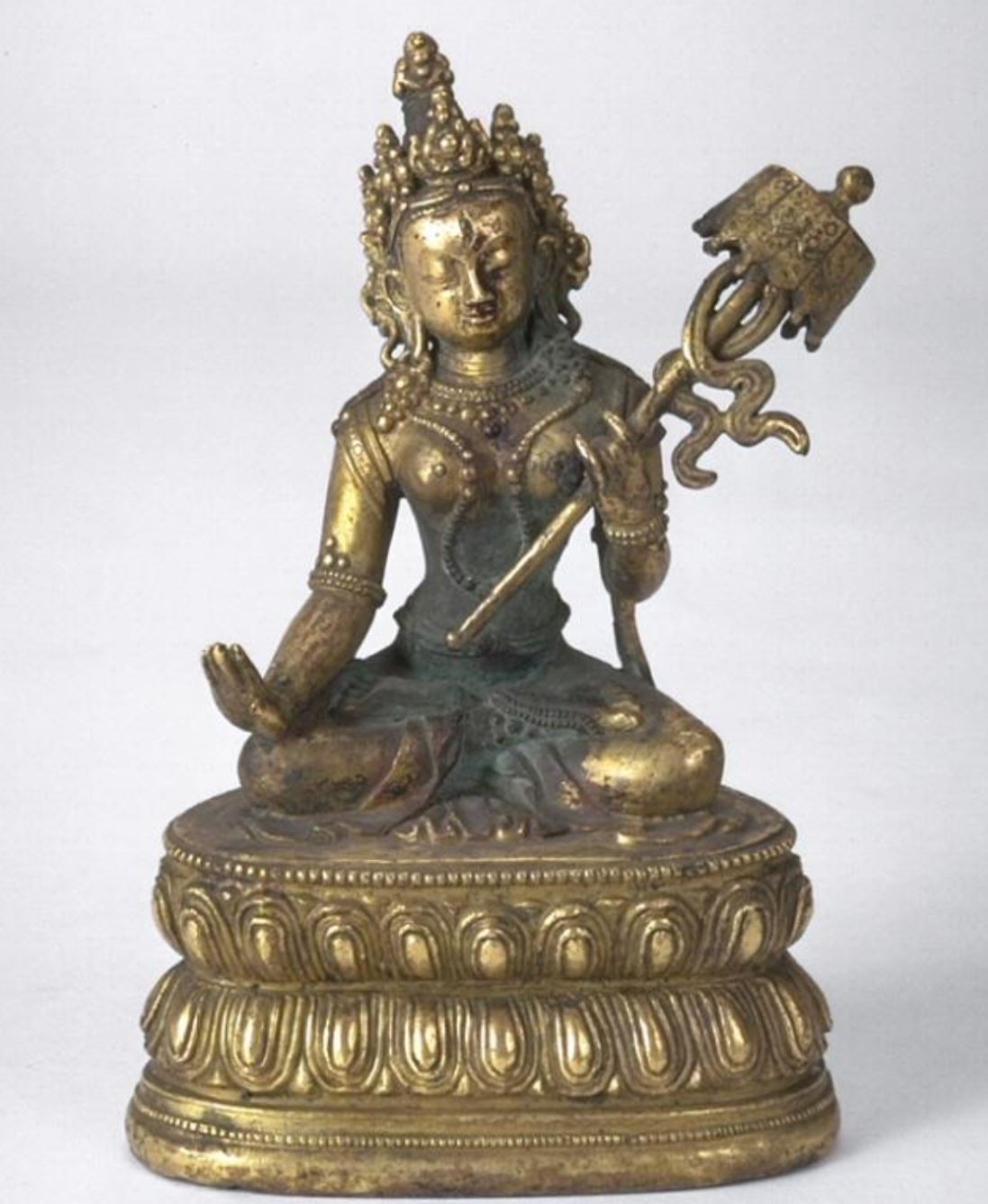
06. Marichi, Marici, Vajravarahi, Asokakanta, Vajravarahl or Vajrayogini., Marishiten.
Marichi, Vajravarahi or the adamantine sow is often yellow or red colored, and removes outer obstacles and is a form of Vajrayogini. Marichi is said to descend from Vairocana.
Vajravarahi can sometimes be seen riding chariot drawn by seven or nine pigs or sitting on a throne of nine pigs (pigs represent ignorance).
One to a number of heads, of which one is that of a sow head (varahi) placed either on the right side of her head or on the top of her head.
She has to to eight arms holding various implements including an asoka (branch), and vajra (thunderbolt).
Consort of Hayagriva or Chakrasamvara, the presiding deity of the Samvaratantra.
In Tibet, Marichi is considered to be a form of the goddess Vajravarahi. It is not unlikely that Vajravarahi and thus as well Marichi is conceived by Buddhist teachers as an answer to the Hindu Varahi, one of the mother goddesses or originated from Ushas, the goddess of Indian mythology. She is enshrined as the self defence goddess that protects people from things that cannot be seen using the magical power.
She is associated with the sun and with dawn. Her mantra is traditionally used as protection by travellers.
OṂ I bow to you, Bhagavatī Vajravārāhī HŪṂ HŪṂ PHAT
OṂ before you, the arya lord of knowledge women who do not turn from conquer the three realms HŪṂ HŪṂ PHAT
OṂ before you who fear all evil forces with your great vajra destroy HŪṂ HŪṂ PHAT
OṂ before you who sit on the vajra throne and through your powerful eye cannot be conquered by others HŪṂ HŪṂ PHAT
OṂ before you, whose wrathful body of inner heat the drying up of Brahma causes HŪṂ HŪṂ PHAT
OṂ before you who triumph over opponents by putting the maras in Frightened and desiccated HŪṂ HŪṂ PHAT
OṂ before you who overcome that which dulls, paralyzes, or causes confusion HŪṂ HŪṂ PHAT
OṂ I bow to you, Vajravārāhī, the Yoginī, the power over the desire has HŪṂ HŪṂ PHAT
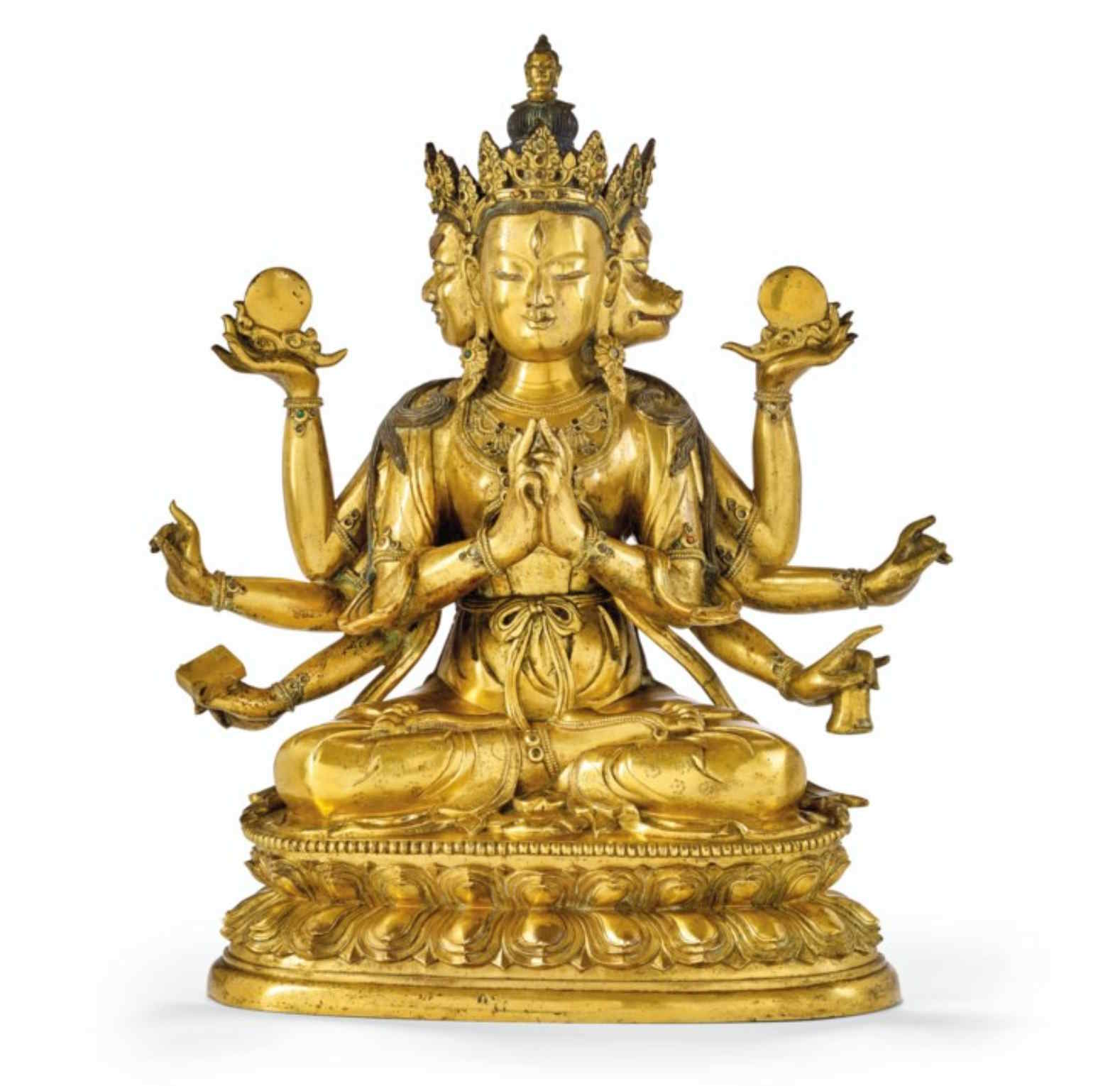
07. Ushnishavijaya.
Ushnishavijaya the victorious is the goddess representation of long life.
Ushnishavijaya is a peaceful white deity and an emanation of Vairochana Buddha.
Sometimes she is shown with three heads or faces, ten eyes and eight hands.
Sometimes she holds a double thunderbolt.
Sometimes the right hands hold a lasso, bow, and vase with the nectar of immortality; her fourth right hand bears an eye in the palm and is in the mudra (posture) of generosity. Her left hands hold a miniature Buddha image, a double (crossed) vajra, and an arrow; the fourth left hand is held in meditation posture in her lap.
Ushnishavijaya is often shown in a triumvirate with the other two principal long-life deities, red (male) Amitayus and White Tara.
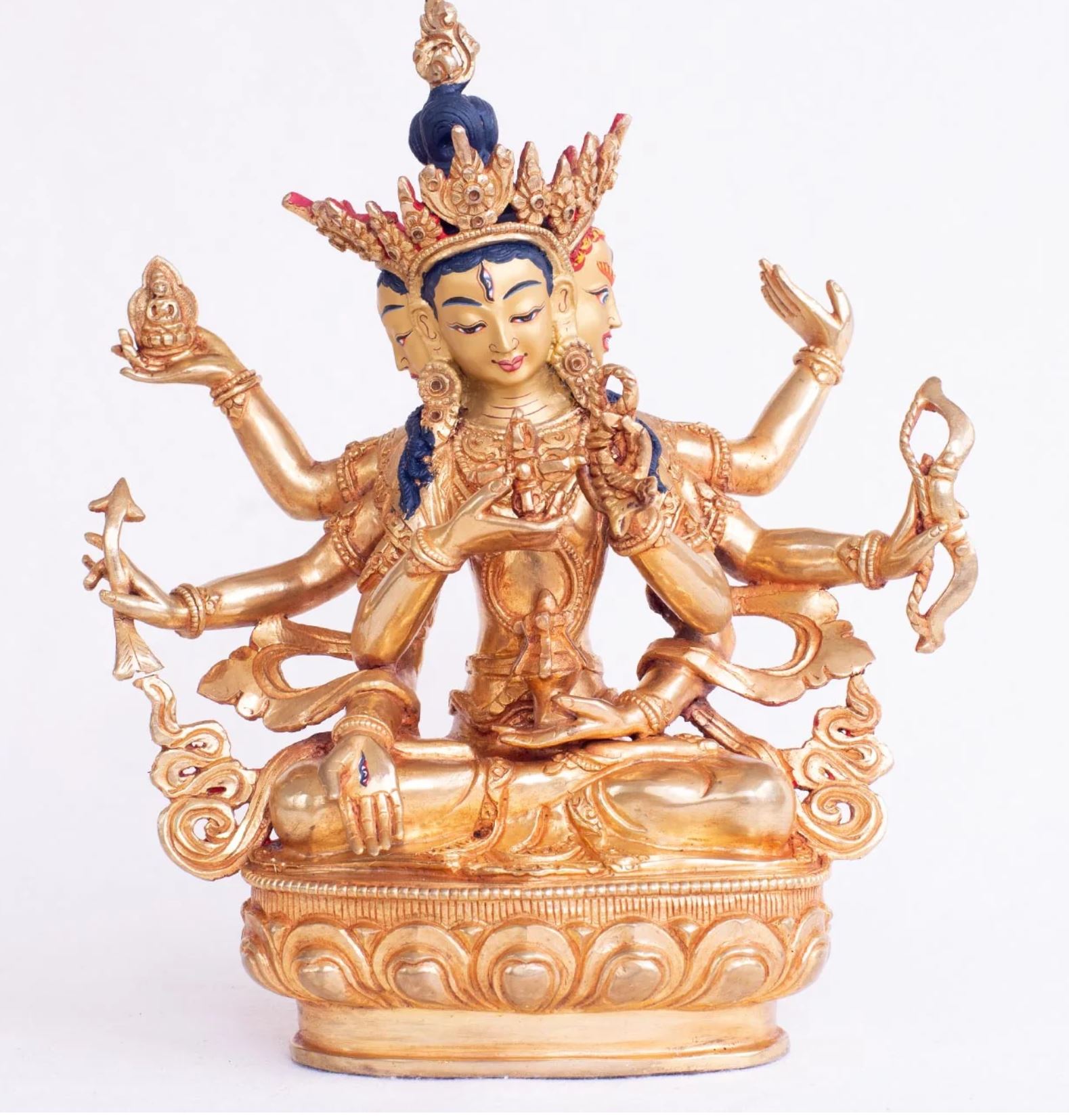
08. Parnashavari or Parnasavari.
Three heads, six or eight arms, and an apron of leaves.