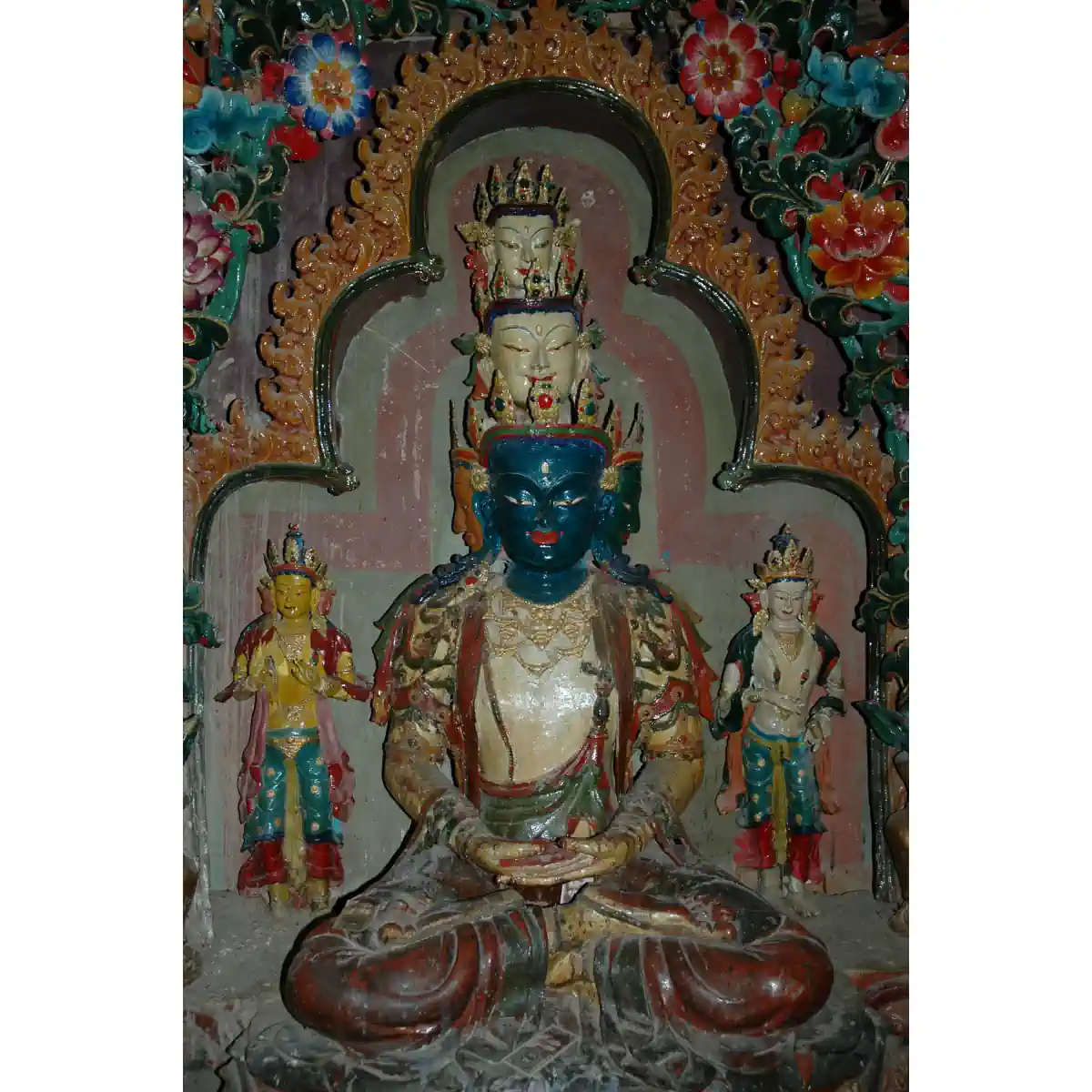
01. Forms or matter. (Rūpa, rupam).
Rupa is form or matter of the physical world, material that can be sensed. This includes the body, which can be analysed in terms of the four elements as the four elements are the cause and condition for the discernibility of the form aggregate.
With cold and heat and hunger and thirst, with the touch of flies, mosquitoes, wind, sun, and reptiles, because it is afflicted, it is called form.
At the center of my forehead for my aggregate of forms,
A white BHRUM transforms into white Vairocana, with his right hand holding up a wheel and his left haughtily resting a bell on his hip.
Ananda, why are the five aggregates fundamentally the wondrous nature of the Absolute of the Tathagata store? Ananda, for instance, when a man looks at a clear sky with clear eyes, he sees only the void which contains nothing. If suddenly without any apparent reason he steadies his seeing, it will be disturbed and he will see flowers dancing and other objects moving in the sky. It is the same with the aggregate rupa. Ananda, these dancing flowers come neither from the void nor from his eyes. If they came from the void, they would return to it; if there was really such a coming and going of these flowers, the void would not be empty. If voidness was really not empty, then they could not appear and vanish in it. This is like Anandas body which does not allow‚Ananda to enter it. If these flowers come from the eyes, they should be able to return to the eyes, and because they come from seeing, they should be able to see. Thus when they leave the eyes, they become flowers in the sky and when they return, they should see the organ of sight. If they cannot see (things), then when they leave, they should screen the sky and when they return, they should veil the eyes; but when the man sees these flowers, his eyes are not veiled. Then why do you wait until the sky is clear to say that your eyes are really clear? Therefore, you should know that the aggregate form is unreal for it is neither causal nor conditional nor self-existent.
02. Feeling or sensations. (Vedanā).
Vedana is the sensation experienced through the contact of eye with visible form, the ear with sound, nose with odour, tongue with taste, body with tangible things, mind with ideas or thoughts. Sensations can be pleasant, unpleasant or neutral.
As this is the experience of pleasure or pain, it conditions craving, to acquire something pleasurable or avoid something painful, these are our responses to experience, likes, dislikes, or indifferences.
Contact is the cause and condition for the discernibility of the feelings, perception and fabrication.
Ratnasambhava is seen as representing the aggerate of feeling, (Ratnasambhava is sometimes called Vajrasurya).
At my navel for my aggregate of feelings of levels of happiness,
A yellow AM transforms into yellow Vajrasurya, with his right hand holding up a jewel, and his left haughtily resting a bell on his hip.
Ananda, when, for instance, a man is in good health and his limbs are in good condition, he does not feel anything. But if suddenly, without any reason, he rubs his palms together, he feels coarseness, smoothness, cold and warmth. It is the same with the second aggregate vedana. Ananda, these sensations come from neither the void nor his palms. If they come from the void, why are they felt by his palms only and not by his body? It should not be up to the void to choose his palms to feel them. If they come from his palms, they should not wait for the palms to be brought together to be felt. Moreover, if they really come from his palms and are felt when the latter are brought together, when they are separated, these sensations should re-enter the palms, arms, shoulders, bones and marrow which should also feel their reentry. They should also be felt by the mind as coming in and out, as if something had moved in and out of the body. If so, there is no need to bring the two palms together to feel these sensations. Therefore, you should know that the aggregate vedana is unreal and is neither causal nor conditional nor self-existent.
03. Perceptions/Cognition. (Saṃjñā, saññā, samjfia or sanjna).
Samjna is the capacity to conceptualize and recognize things by associating them with other things. We might associate an object with its context or based on our previous understanding of a like object.
Contact is the cause & condition for the discernibility of the feelings, perception and fabrications aggregates.
It perceives blue, it perceives yellow, it perceives red, it perceives white. Because it perceives, it is called perception.
Crossing Over from Cyclic Existence, i.e. Amitabha, who “crosses over” from his abode in the Western paradise to help being is spoken of as perception, Amitabha is sometimes called Padmanarteshvra).
At my throat (for my aggregate of distinguishing), a red HRI transforms into red Padmanarteshvara,
With his right hand holding up a red lotus and his left haughtily holding a bell on his heart.
Ananda, if someone speaks of sour plums, your mouth will water, and if you think of walking above an overhanging cliff, you will have the sensation of shivering in the soles of your feet. This is the same with the third aggregate sanjna. Ananda, this talk of sourness does not come from the plum, nor does it enter your mouth. If it comes from the plum, it should be spoken of by the plum itself; then why does it wait for someone to speak of it? If it enters your mouth, it should be your mouth which actually talks about it; then why does it wait until your ears hear of it? If it is your ears which alone hear it, why does not that water come out of them? This is the same with your thought of (walking above) an overhanging cliff. Therefore, you should know that the third aggregate sanjna is neither causal nor conditional nor self existent.
04. Mental formations, volition or fabrications. (Saṅkhāra, samskarah, or saṃskāra).
Biases and prejudices, interests and attractions. i.e. Conditioning which also includes the process that makes a person initiate action or act.
Contact is the cause and condition for the discernibility of the feelings, perception and fabrications aggregates.
Fabrications are from the these six classes of intention: intention aimed at sights, sounds, aromas, tastes, tactile sensations, and ideas.
From form-ness, the mental formations fabricate form as a fabricated thing. From feeling-ness, mental formations fabricate feeling as a fabricated thing. From perception-hood, from fabrication-hood, from consciousness-hood, mental formations fabricate consciousness as a fabricated thing. Because mental formations fabricate fabricated things, they are called fabrications.
The Wisdom Holder Amoghasiddhi is stated as compositional factors (Amoghasiddi is sometimes called Vajraraja).
Below the ankles of (each of) my two feet (for my aggregate of other affecting variables),
A green HO transforms into green Vajra-raja,
With his right hand holding up a crossed double-vajra
And his left haughtily holding a bell at his heart.
Ananda, the fourth aggregate sanskara is like water which flows in a torrent endlessly and in good order over a fall.
Ananda, this flow does not come from the void nor is it due to the water; it is neither the water itself nor does it exist apart from the void and the water. If it is created by the void, boundless space would become an endless flow of water and the whole world would be submerged. If it is due to the water, then it should not be water and should have its own form and location which should be apparent. If it is water, then still and clear water should not be water. If it exists apart from the void and water, (this is impossible because) space (is all-embracing and) has (nothing) outside (it) and because there is no flow without water. Therefore, you should know that the fourth aggregate sanskara is false and is neither causal nor conditional nor self-existent.
05. Consciousness. (Vijnana, vijfianam or Vinanna).
Reaction to senses and the base which supports experience.
Name and form are the cause and condition for the discernibility of the consciousness aggregate.
The consciousness cognizes what is sour, bitter, pungent, sweet, alkaline, non-alkaline, salty, and not salty. Because it cognizes, it is called consciousness.
Just as fire is classified simply by the condition in dependence on which it burns, a fire burning in dependence on logs is classified simply as a log fire, a fire burning in dependence on rubbish is classified simply as a rubbish fire; in the same way, consciousness is classified simply by the condition in dependence on which it arises.
The Vajra Holder Aksobhya is stated as consciousness, or sometimes Vajrasattva.
At my heart (for my aggregate of consciousness),
A white HUM transforms into white Vajrasattva, with his right hand holding a vajra at his heart, and his left haughtily resting a bell on his hip.
Ananda, the (fifth) aggregate consciousness is like the void in an empty pitcher with two mouths. If someone blocks both mouths and carries it to another country, the void does not go from one place to another. If the void comes from somewhere, that place should lose some of its voidness, and on arrival elsewhere, when the mouths are opened and the
pitcher reversed, one should see the void poured out of it.
Therefore you should know that consciousness is unreal and is neither causal nor conditional nor self-existent.