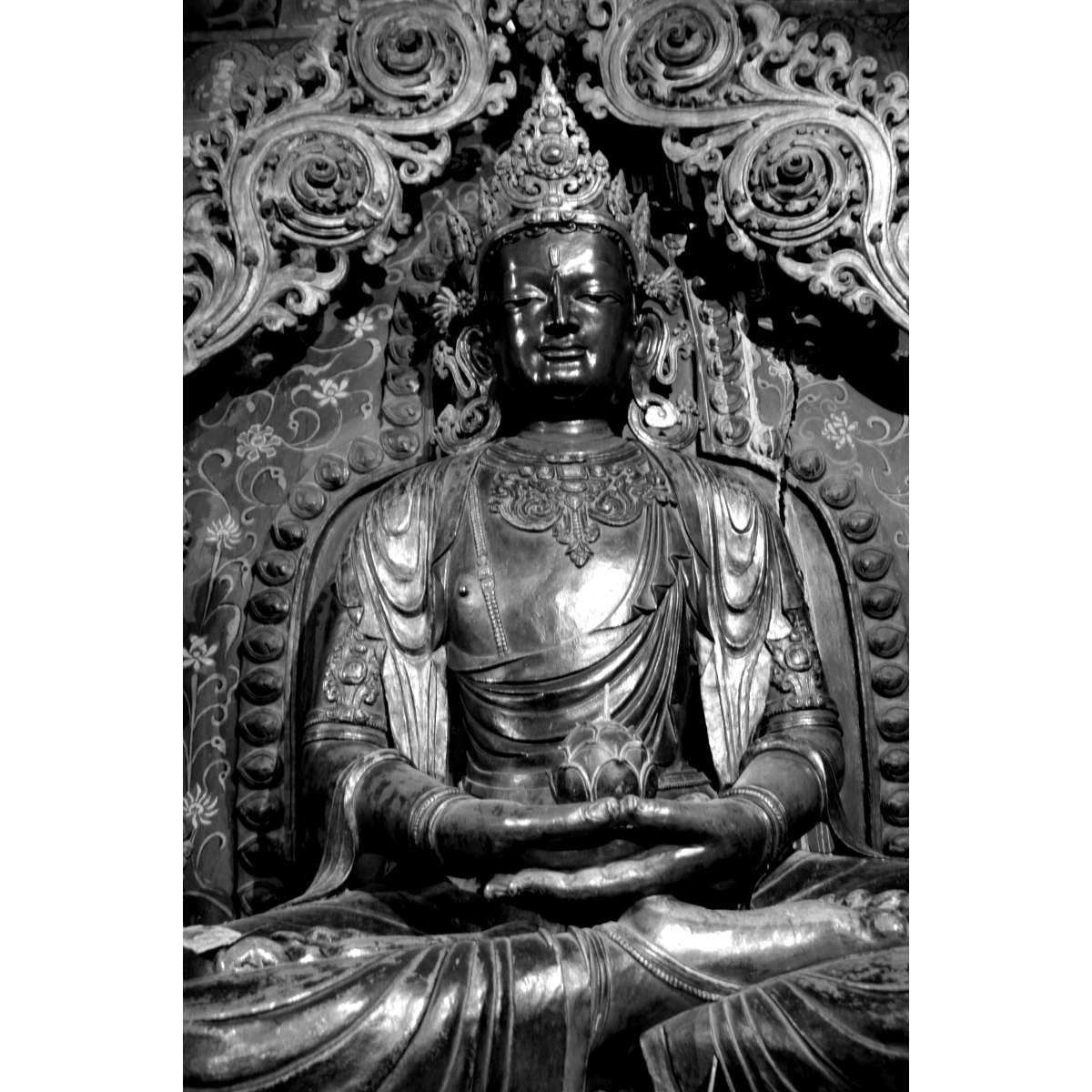
01. Legs positioned in the vajra posture.
Sit flat with the legs crossed, the left leg inside and the right leg outside. Alternately, use the bodhisattva posture and sit in a chair in a relaxed manner with both feet flat on the floor.
The vajra leg position is said to force vital energy to flow in the central channel.
The ideal is to sit in the full lotus position, which involves crossing the legs while sitting on the ground or a flat surface, with the top of each foot resting on the opposite thigh, though as above, people unable to sit in cross-legged position may sit on a chair while practicing the other points of the posture. The main objective is to adopt a posture that fosters a calm and alert mind so there should be no discomfort.
02. Straight spine.
Hold your back erect from the tail bone to the base of the skull. If your spine is not straight, your central channel will not be straight, so hold your entire back upright, erect means maintaining a poised, alert posture, neither rigid, nor slumped. This is the most important element of the posture, for both spiritual and health purposes and alertness during meditation practice and enables energy to move more freely through the body’s subtle energy channels.
The most important elements of the seven fold posture are holding your spine straight and opening your shoulders. Straightening the spine straightens the entire central channel. Sometimes the winds will flow into the central channel but do not remain there.
03. Shoulders open and relaxed.
The shoulders should be spread slightly back, not slumping forward in order to open up the chest. This also helps keep your spine straight.
This posture helps reduce stress and also helps to foster an alert, attentive mind, rather than one that is distracted or dull.
Opening the shoulders and therefore your chest when you are stressed, you can feel an immediate release of tension.
04. Hands flat on your lap.
The hands should be held in the meditation posture four finger widths below the navel. Palms up, the right hand is on top of the left with the thumb tips touching.
The hand meditation posture brings the water energy into the central channel. The water energy, or life force, is the vitalizing energy at the heart.
05. Eye gaze.
The gaze should be set neither too close nor too far from you. The distance should be close enough to reduce distractions and to allow you to remain focused. When your eyes see less, you generate fewer conceptual thoughts. The mind has a bad habit of following wherever your gaze goes, which leads to the rising of conceptual thoughts. You may also allow your eyes to naturally close.
The eyes gazing at the tip of the nose, without focus, and the tip of the tongue touching the palate serve to strengthen the wind element within the central channel. This helps unblock the central energy channel.
Meditating with the eyes open is preferred, as trying to meditate with closed eyes can promote drowsiness or a wandering mind.
06. Tongue lightly touching just behind the front teeth.
Your mouth is slightly open and the tip of the tongue touches the palate.
Keeping the lips and the teeth slightly open helps to maintain our vital essence by reducing the saliva flow and the distraction of swallowing often that goes with it.
07. Neck bent slightly forward.
The chin is slightly lowered, i.e. tucked slightly down toward the neck.
Holding the neck slightly forward with the chin slightly lowered is associated with the heat energy. The energy moves upward like a blazing fire, and is sometimes called the upward wind.
This energy is active when we exhale or speak and is forcefully brought into the central channel with this posture.