01. Hanging Gardens Of Babylon.
Babylon was the capital city of the ancient Babylonian empire, and its ruins can be found about 85 km south of modern-day Baghdad, on the banks of the Euphrates River, in Iraq.
There are lots of different theories about what the Hanging Gardens of Babylon might have looked like, and where they might have been built. They might have been rooftop gardens, or raised terraces, located near the royal palace with a complex irrigation system. We can’t even be sure that they ever existed.
It is thanks to the Babylonians (and the Sumerians) though that we have the counting system of 60 seconds to a minute, and 60 minutes to an hour.
02. Statue Of Zeus At Olympia.
Built in the fifth century B.C. in Greece, This 40-foot (12-meter) statue depicted the king of the Greek gods.
03. Mausoleum At Halicarnassus.
The Mausoleum of Halicarnassus was built as a tomb for the ruler of Caria, Mausolus, following his death in 353 BC. Halicarnassus itself was the kingdom’s capital city, located on the south-west coast of modern-day Turkey.
After Mausolus’ death it was Artemisia II, who was both his wife and sister, who became ruler. She oversaw the building of a great tomb, sat atop a hill overlooking Halicarnassus.
Around 41 metres tall and decorated with sculptures and friezes by four leading Greek artists, it would have been a sight to behold. Right at the top, stood on a pyramid, was a four-horse marble chariot. So splendid was this tomb, that Mausolus’ name is forever linked with any stately or imposing building containing the dead - a mausoleum.
It is thought that the Mausoleum of Halicarnassus was destroyed by earthquakes, but remnants do survive and can be seen in the British Museum.
04. Temple Of Artemis.
Built in the sixth century B.C. in Ephesus, Turkey, to honor Artemis, the Greek goddess of the hunt, this temple was said to have housed many works of art.
05. Lighthouse Of Alexandria.
Built in the third century B.C. in Egypt and towering over the Mediterranean coast for more than 1,500 years, the world's first lighthouse used mirrors to reflect sunlight for miles out to sea.
06. Colossus Of Rhodes.
Sculpted by Chares of Lyndus, around 294-282 BC, this colossal statue of Helios was created to commemorate the lifting of a year-long siege of Rhodes in 305 BC.
At 32 metres tall, it was made of bronze which was then reinforced with iron. Unfortunately, the iron wasn’t strong enough and the whole thing toppled over following an earthquake in around 225/226 BC. It lay shattered on the ground until AD654, when enemy raiders took the different bits away to be sold for scrap.
Many descriptions and illustrations of the Colossus of Rhodes depict the statue legs astride, a foot either side of the Mandrákion harbour. However, this would have been physically impossible using the casting techniques of the time.
Helios was the god of the Sun and was closely associated with Rhodes. As the personification of the Sun, the Greeks believed he drove a chariot across the sky every day, from east to west, dawn until dusk.
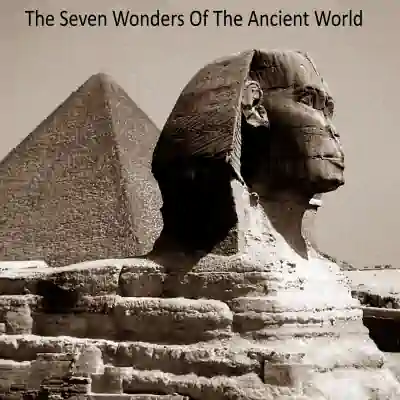
07. The Great Pyramid Of Giza.
A massive tomb of an Egyptian pharaohs, the pyramid is the only ancient wonders still standing today. The tallest of the three pyramids is called the Great Pyramid.