 

The Six Noble Gases - List

  5.00/5.00 - (1 votes for article, provide comments and help us improve if required.)

Noble gases are gases characteristics are that they are odourless, colorless, and tasteless under normal conditions and are made up of single atoms and have exceptionally low chemical reactivity.

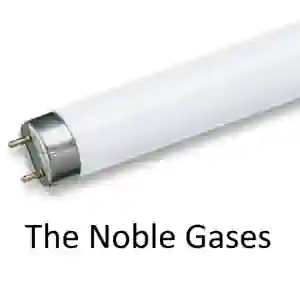
The Six Noble Gases - ListA neon tube representing rare gases.A neon tube representing rare gases.A neon tube representing rare gases.
List of noble gases.

The noble gases can be found in the atmosphere of the earth, and, except for helium and radon, their major commercial source is from the air, obtained by liquefaction and fractional distillation.
Noble gases are typically highly unreactive except when under extreme conditions. The inertness of noble gases makes them very suitable in applications where reactions are not wanted.
Found in the periodic table, their outer shell of valence electrons is full, giving them little tendency to participate in chemical reactions, they also have very high ionization energies (as their electrons are pulled strongly toward the nucleus), and have and negligible electronegativity because they have no little ability to easily gain or lose an electron.
These gases are in the noble gases group, Group 18, of the periodic table, the gases can be found on the far right of the periodic table.
Listed below are the six naturally occurring noble gases.

The Six Noble Gases

01. Helium (He).

Uses of helium (He) include, as it much less dense than air (lighter), filling weather balloons, airships, and decorative balloons. Helium is also used to cool metals down to extremely low temperatures so that they lose their electrical resistance and become super-conductors. Helium is the second most abundant element in the universe after Hydrogen.
Helium is No. 2 on the Periodic Table of Elements meaning it has two protons.

02. Neon (Ne).

Uses of neon (Ne) include, filling of advertising signs, Neon glows a reddish orange colour when electricity is passed through it in a vacuum discharge tube, red signs will usually contain pure neon. Neon is lightweight and colorless in general.
Neon is under Helium in the periodic table.
Neon is No. 10 on the Periodic Table of Elements meaning it has ten protons.

03. Argon (Ar).

Uses of argon (Ar) include, use in incandescent light bulbs instead of air as it will not react with the tungsten filament even when it is white hot , also useful in metallurgical (metal working) processes, to provide the necessary inert atmosphere for welding titanium, aluminium, stainless steel, and magnesium (they limit the amount of oxygen and water vapour from the join to prevent oxidation).
Argon is under Neon in the periodic table.
Helium is No. 18 on the Periodic Table of Elements meaning it has eighteen protons.

04. Krypton (Kr).

Uses of krypton (Kr) include, creating photo flashes for high-speed photography, advertising signs, as when paired with an electrical charge, krypton glows bright green.
Krypton is under Argon in the periodic table.
Krypton is No. 36 on the Periodic Table of Elements meaning it has thirty six protons.

05. Xenon (Xe).

Xenon (Xe) does not glow when you introduce an electrical current, instead, it flashes a brilliant white light, in terms of its use, it makes for a perfect strobe light. It can also be used for sterilization as its light is such a frequency that it can destroy bacteria on surfaces and in the air. Xenon is an odorless, colorless gas, but when it is put in a vacuum tube and excited with electricity it can glow blue.
Xenon is under krypton in the periodic table.
Xenon is No. 54 on the Periodic Table of Elements meaning it has fifty four protons.

06. Radon (Rn).

Uses of radon (Rn) include, radiotherapy, places such as Bad Gastern in Austria and Onsen in Japan offer a therapy in which people sit for minutes to hours in a high-radon atmosphere, believing (i.e., not proven) that low doses of radiation will boost up their energy.
Radon is under Xenon in the periodic table.
Radon is No. 86 on the Periodic Table of Elements meaning it has eighty six protons.

07. Oganesson (Og).

Oganesson is a radioactive, artificially produced element , it is expected to be a gas and is classified as a non-metal. It is a member of the noble gas group.
The element, No. 118 on the Periodic Table of Elements, had previously been designated ununoctium, a placeholder name that means one-one-eight in Latin. In November 2016, the International Union of Pure and Applied Chemistry approved the name oganesson for element 118.
Since only a few atoms of oganesson have ever been made, it has no practical uses outside of scientific study.
Oganesson is No. 118 on the Periodic Table of Elements meaning it has one hundred and eighteen protons.

Synonyms/tags: noble gases, nobel gases, chemistry noble gases, rare gases, inert gases,edelgas


Or, why not search for other related lists on our site;

Or, want to know more? Then more information can be found from external resources at this other website The Six Noble Gases.

Or, watch a related video from YouTube by clicking below;


This list was published by Here There, Everywhere and is a printable check-list; To print, hold down the key marked "ctrl", and whilst holding that down, press the "p" key.
This is a downloadable list, select here, if you would like to download the The Six Noble Gases - List as an excel or .csv file. Or find the print function on your browser (top right, three dots, print) and print to a pdf printer if you would like to download as a pdf file, or print to a pdf file.

If you are interested in advertising with us reach out via the contact page below. If you would like to share viewers, and your site is related with great content, then feel free to use the code below on your site then reach out via our contact page and we will look for a place to mention you.


Otherwise, suggest improvements, request additional items, report typos, errors or misspellings, ask us questions or just say hello via the comments here below, we are always pleased to hear from you.

Comments HistoryBe a pioneer and write the first comment.

Note: Current average rating of 5.00 based on 1 reviews and ratings. (1-Low, 5-High)

Note: Comments and ratings help this site get better; if you see something missing, see something wrong, have a question, or want to suggest something to improve then comment below and join the dialogue;

Comments


Looking for something else? Then search the rest of the internet here. If you do like what you see then come back sometime and create your own checklist here. If the item does not have a checkbox next to it, its probably a folder which you can open by clicking. If there are actions listed against an item on the right hand side you can visit websites, download as excel/csv for xls, or create an ical calendar entry.

If you found this page useful, share it, or like us using the buttons on the bottom right, it helps us to improve.

This webpage with information about The Six Noble Gases has the following attributes;
The list was authored by .

« Go look for more free lists & checklists