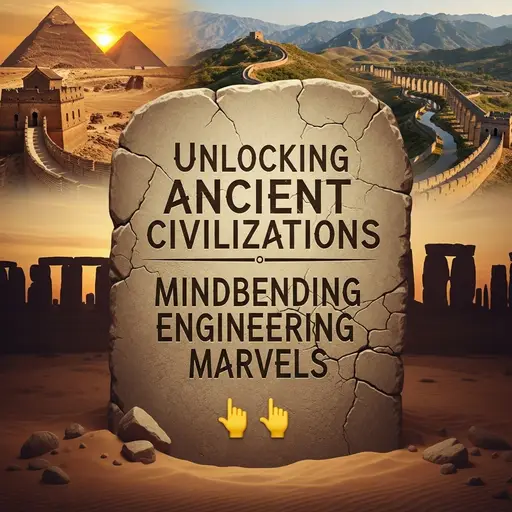
1. Giza Pyramids' Precision Alignment
The Great Pyramid of Giza stands as a testament to unparalleled ancient Egyptian architectural precision. Its sides align almost perfectly with the cardinal directions, a feat requiring sophisticated astronomical observation and meticulous planning. This astronomical accuracy, achieved over 4,500 years ago, continues to baffle modern scientists and engineers, demonstrating a profound understanding of celestial mechanics and surveying.
10. Stonehenge's Astronomical Alignment
The prehistoric monument of Stonehenge in England is a marvel of megalithic engineering. Its stones are precisely aligned with the solstices, indicating a deep understanding of astronomy and a sophisticated approach to surveying and construction, all achieved without written records or advanced tools.
2. Machu Picchu's Terraced Agriculture
Nestled high in the Andes Mountains, Machu Picchu showcases the Inca Empire's mastery of sustainable engineering. Their intricate terraced farming system prevented soil erosion, maximized arable land on steep slopes, and managed water flow efficiently. These agricultural terraces are a prime example of how ancient societies ingeniously adapted to challenging environments.
3. Roman Aqueducts' Gravity Flow Systems
The Roman Empire's extensive network of aqueducts represents a monumental achievement in hydraulic engineering. These sophisticated structures transported fresh water over vast distances using only gravity, demonstrating an exceptional understanding of gradient and fluid dynamics. Their durable construction and ingenious design facilitated the growth and sanitation of Roman cities.
4. Baalbek's Gigantic Foundation Stones
The Temple of Jupiter at Baalbek, Lebanon, features some of the largest stone blocks ever quarried and moved by ancient civilizations. The 'Trilithon' stones, weighing hundreds of tons, pose a significant question about the methods used for their extraction, transportation, and precise placement, highlighting a remarkable level of ancient engineering prowess.
5. The Antikythera Mechanism's Complexity
Discovered in a shipwreck, the Antikythera Mechanism is an ancient Greek analog computer dating back to the 2nd century BCE. This intricate device, with its complex gear trains, was used to predict astronomical positions and eclipses. Its sophistication is far beyond what was previously thought possible for its era, marking a pivotal moment in early mechanical computing.
6. Petra's Rock-Cut Architecture
The Nabataean city of Petra, Jordan, is renowned for its stunning architecture carved directly into sandstone cliffs. The intricate facades, tombs, and water management systems were all achieved through subtractive sculpting, showcasing an intimate knowledge of geology and an artistic vision that transformed natural formations into habitable spaces.
7. Angkor Wat's Moat and Reservoir System
The vast temple complex of Angkor Wat in Cambodia is surrounded by an immense moat and an intricate system of reservoirs and canals. This sophisticated hydraulic engineering not only served defensive purposes but also managed water resources for agriculture and provided a stable foundation for the massive structures, demonstrating advanced water management principles.
8. The Library of Alexandria's Hydrodynamics
While primarily known for its lost knowledge, the construction and operation of the Great Library of Alexandria likely involved sophisticated engineering, potentially including early applications of hydrodynamics for its water systems or even rudimentary mechanical devices. The ambition of such a scholarly institution implies significant infrastructural planning.
9. Teotihuacan's Urban Planning
The ancient city of Teotihuacan, Mexico, exhibits remarkable urban planning with its grid layout, monumental pyramids, and sophisticated drainage systems. The precise alignment of its major structures with celestial events and its well-organized infrastructure demonstrate a high degree of societal organization and engineering foresight.